Ten years ago, Dr. Peter Stoicheff (PhD) embraced the immense responsibility and the opportunity ahead as he was introduced as the 11th president in the history of the University of Saskatchewan (USask).
"This is a university whose future rests on its great potential to inquire, to inform, to innovate, and to Indigenize, and I am very thankful I am humbled to be able to play a role in it," Stoicheff said when he was announced as president on July 9, 2015.
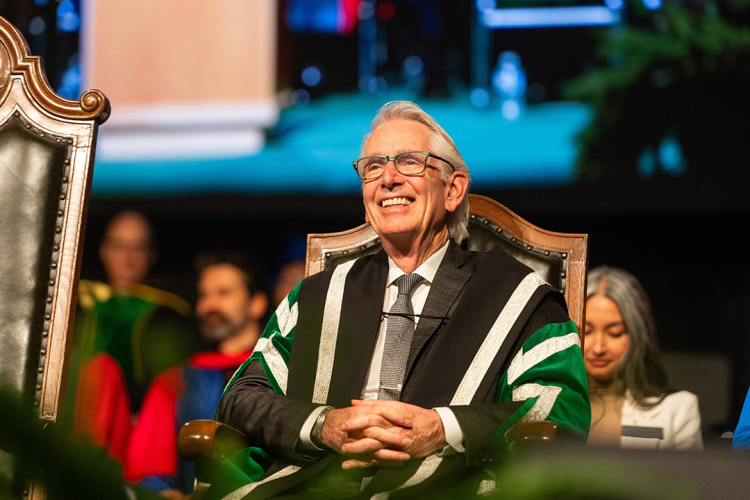
University of Saskatchewan President Peter Stoicheff at his final USask convocation ceremony on Nov. 12, 2025, at Merlis Belsher Place. (Photo: Dave Stobbe)
A decade of development later, Stoicheff is wrapping up his second five-year term as president, having led the university through everything from a global health crisis to a record-setting fundraising campaign, and firmly establishing USask as a leader in research, scholarly and artistic work, as well as innovation and Indigenization.
From the start of his presidency, Stoicheff made Indigenization a priority, crediting former Chancellor Blaine Favel's leadership as the key to driving USask's initiatives, including hosting the first national Building Reconciliation Forum in the fall of 2015 and the opening of the Gordon Oakes Red Bear Student Centre in 2016. From there, the university engaged with Indigenous leaders and communities to commit to work together through Memorandums of Understanding (MOUs), including with the Federation of Sovereign Indigenous Nations (FSIN), Métis Nation Saskatchewan (MN-S), and Inuit Tapiriit Kanatami (ITK), among many others.
On campus, the university established the Office of the Vice-Provost Indigenous Engagement, weaved Indigenization throughout the University Plan 2025 that was launched in 2018, increased Indigenous student scholarships and supports, and adopted ohpahotân | oohpaahotaan the Indigenous Strategy in 2021, and deybwewin | taapwaywin | tapwewin the Indigenous Truth Policy on citizenship/membership in 2022.
"What we were able to achieve collectively as a university was to make Truth and Reconciliation part of what we are always thinking about and what we're always working on at the university, at all levels, in all colleges, in all aspects of our mission," said Stoicheff. "So I am pleased to see the progress that we have made. I think we all know that it is a long road to true reconciliation and that universities have a leading role to play."
USask also signed historic MOUs with the City of Saskatoon, Remai Modern, Saskatoon Symphony Orchestra (SSO), and Wanuskewin Heritage Park, solidifying the university's connection to the city in reciprocal relationships.
"I asked myself as a president with a humanities and fine arts background, what distinctively could I bring to this presidency? And one of the answers was I wanted to be deliberate about connecting with the biggest cultural institutions in the province and the city," said Stoicheff, who began his 39 years at USask as a professor in 1986 and served as dean of the College of Arts and Science before becoming president. "That initiative led to the MOUs with the SSO and the Remai Modern. I'm sure we were the first major research-intensive university to sign an MOU with a world-class art gallery and symphony. And we were definitely one of the first universities to sign an MOU with a city."
The university's increased connection to community over Stoicheff's time in office has included more distributed learning sites across the province (particularly nursing), creating community dental clinics, as well as full medical education made available from start to finish in Regina, and the establishment of the Prince Albert Campus that was one of Stoicheff's early commitments.
"The P.A. Campus has been extremely important," Stoicheff said. "We don't think of it as a gateway to the north, we think of it as a hub. And if a university is a beacon of hope for people, you want that beacon of hope to be achievable for as many people as possible, particularly for remote and northern communities."
The P.A. campus was completed in 2020, the year the pandemic changed everything, as USask quickly transitioned to remote teaching and learning until 2022. Under Stoicheff's leadership he is quick to credit his senior leadership team and the entire campus community USask successfully navigated the global health crisis and came out the other end stronger than ever.
"There was nobody in the university who was not deeply affected by it and everyone stepped up to get the university through it successfully," he said. "Secondly, it showed how well we could work together when the chips were down. The third thing is it showed how we are capable of change and how we are, to use the language of the time, nimble and able to pivot.' It taught us that when faced with challenges, we have the wherewithal to make enormous changes to meet those challenges and to make those changes extremely quickly, in the span of a few days."
USask was the first university in Canada to adopt a vaccine mandate and resumed in-person teaching and learning in early 2022.
"We were the first to come up with a vaccine mandate and it was controversial. Not very controversial on campus, but in the public domain, that was a courageous thing to do," Stoicheff said. "And that was the result of a whole lot of people teaming up for the betterment of the whole the herd, the pack. So despite the gravity and at times tragedy of the pandemic, it was a time of self-discovery and confidence-building at the university."
That confidence carried into record research funding at USask, including the Vaccine and Infectious Disease Organization (VIDO) becoming Canada's Centre for Pandemic Research, with funding to build the second Level 4 containment facility in the country. USask was also awarded $170 million 25 per cent of all Canada Foundation for Innovation Major Science Initiatives funding in 2022 to support its national research centres VIDO, Canadian Light Source, Super Dual Auroral Radar Network, and the new Global Water Futures Observatories, and also received a record $417 million in research funding in 2023/24.
Stoicheff is quick to credit this period of record research funding to USask's most recent vice-presidents of research, Dr. Karen Chad (PhD) and Dr. Baljit Singh (PhD).
"One of the things that I wanted to see accelerate here was the research, scholarly, and artistic work mission of the university," said Stoicheff, who was born in Ottawa and earned degrees from Queen's University and the University of Toronto, where he completed his PhD in literature in 1983. "That began before me and we have had, during my time, two superb VPs of research in Karen Chad and Baljit Singh. They are extraordinary leaders on the research front, and that's not to deflect praise. Our VPs of research and our excellent research community at USask are why we have been able to achieve what we have achieved."
Stoicheff also elevated USask's reputation as one of the country's leading medical-doctoral research universities when he was elected chair of U15 Canada in 2023.
"As I sat around the U15 table, it became more apparent what a research powerhouse this university is and it was very meaningful for me to be able to chair that group for an extended term of three years," he said. "I think that was useful for raising the profile of the University of Saskatchewan because there hadn't been chairs of the U15 from anywhere other than Ontario, Quebec, and B.C. So that has been very exciting over the last 10 years to see that research momentum accelerate."
USask's research renaissance resulted in a rapid rise in rankings on the international university scene. Among the highlights, USask was ranked first in Canada and as high as No.15 in the world in water research rankings in 2021, cracked the top 100 in the world in sustainability rankings in 2023, and achieved its highest-ever performance in the QS World University Rankings to be named the most improved university (over the previous five years) in Canada in 2024.
"I've always felt that we deserved those kinds of rankings, but I am very gratified on behalf of everybody who has worked so hard here, to see that acknowledgement," said Stoicheff. "I foresee that we will continue to climb in all the most important rankings that we are a part of. The success in rankings continues to add to the value of a University of Saskatchewan degree and it also helps us to attract top talent from around the world."
With a proud global alumni family of nearly 178,000, USask features students from 130 countries, including post-doctoral researchers from around the world and six homegrown Rhodes Scholars in the past four years. Only 11 Rhodes Scholarships are awarded each year to students, shared among Canada's 98 universities.
"With those odds, for a single university to get one Rhodes Scholar is cause for celebration," said Stoicheff. "To get two in one year is almost unheard of. As I have often said, the only other university that I am aware of to have done that recently is the University of Toronto and they have four times the number of students that we have."
USask's rise in reputation has also been reflected in record enrolment, with USask now attracting more than 26,600 students annually (an increase of nearly 2,600 from a decade ago), including close to 4,000 self-identified Indigenous students (an increase of 1,250 from 2015). Fall term enrolment in 2025 also reached a record of 23,888.
"We are all excited to see that because it's not just the numbers, it's also the diversity within those numbers, and that includes many more Indigenous students than ever before," said Stoicheff, who continues to be a vocal opponent of international student visa limits that have significantly affected university diversity and finances across the country. "We have students from 130 countries around the world, which is really exciting to see. And we are committed to supporting those international students, Indigenous students, and all students, to help them graduate and find careers."
Now more than ever, those 4,800 USask graduates each year are remaining in Saskatchewan, with 70 per cent of alumni now staying in the province. Attracting and educating talented professionals is one of the many ways USask supports Saskatchewan's growth plan, with USask directly employing 6,600 individuals and increasing the province's gross domestic product (GDP) by $1.97 billion each year, and increasing the national GDP by $2.4 billion annually.
"For a provincial government to have confidence in its post-secondary sector and in this university, the government and the public have to see that we're aware that all that we do is not about us," Stoicheff said. "It's about supporting so many things, including the prosperity of the province, the innovation agenda of Canada, and in select ways, meeting global challenges."
Meeting the challenge of raising $500 million was a featured focus for the university in Stoicheff's 10th and final year, wrapping up the Be What The World Needs comprehensive campaign on June 18 by raising a record $570,739,155 to fund a broad spectrum of initiatives and innovation, covering everything from health to the Huskies.
"The Huskies have been a big part of my presidency because they are our biggest brand and they are such a community builder, and Huskie student-athletes stand for excellence in all that they do," said Stoicheff.
As he winds down the final days of his presidency, Stoicheff prepares to leave knowing that the university community he cares so much about successfully completed the largest fundraising campaign in the history of the university and in the history of the province.
"The success confirms that our alumni and other donors believe that we are heading in the right direction," said Stoicheff. "It was a team effort. Every college, every unit, students and researchers, were involved, as well as thousands of alumni and donors. So what that campaign means to me is two things that both have to do with confidence: The confidence that others have in us and what we stand for, so that they want to invest in us. The other form of confidence is that the success of the campaign should give us confidence that we can successfully fundraise to achieve the excellence that we aspire to in the years ahead."
For more information

105 Administration Place
Saskatoon Saskatchewan
Canada S7N 5A2
www.usask.ca