



By its very definition, ArtScience is an inherently collaborative field. Integrating arts practices with scientific knowledge requires a fusing of the subjective with the objective, the emotional with the analytical, creating an exploratory community founded in research and innovation.
Nowhere is that more evident than in the work of artist-researcher Joel Ong, whose practice connects scientific and artistic approaches to the environment. A professor in University of Victoria's visual arts department since July 2025, he now holds a Tier II Canada Research Chair (CRC) in Emergent Digital Art Practices.
Ong is exploring the ethical and transformative influences of emerging technologies on artistic practices, including data storytelling, virtual archiving and community-engaged research. Collaborating across disciplinary and institutional boundaries, he uses data and digital fabrication creatively to imagine futures in which species interact in new ways.
He is interested in collaborations with machines and more-than-human species such as microbes or organic materials while thinking about art-making as improvisation and attempting to visualize relationships between them.
Bridging digital and traditional art practices
Complex ideas, to be sure, but a natural evolution given Ong's academic background: he holds a bachelor's in ecology and a master's in biological arts, supplemented by a PhD in digital arts and experimental media. "It's really been a generative, spontaneous path of incremental steps," he says of his journey from the sciences to the arts.
Prior to joining UVic, he was the director of York University's Faculty Makerspace, where he focused on digital fabrication within a fine arts environment a practice he will continue here in the visual arts department by expanding the connections between digital and traditional art forms.
Emergent technologies hold enormous potential. Even within the arts, there is immense variety in the definition and use of technologies . . . [but] these fluidities and openness to emergent media is what makes our department exciting."
Joel Ong, Canada Research Chair in Emergent Digital Art Practices
That said, Ong admits there's a challenge in keeping up with new technologies. "Our students have significantly more time exploring, troubleshooting and developing proficiencies in new technologies than we as instructors do," he says. The solution is to create a mutual learning process involving a combination of creative space, tools for experimentation and a self-reflexive forum to explore the positive and negative aspects of their art practices.
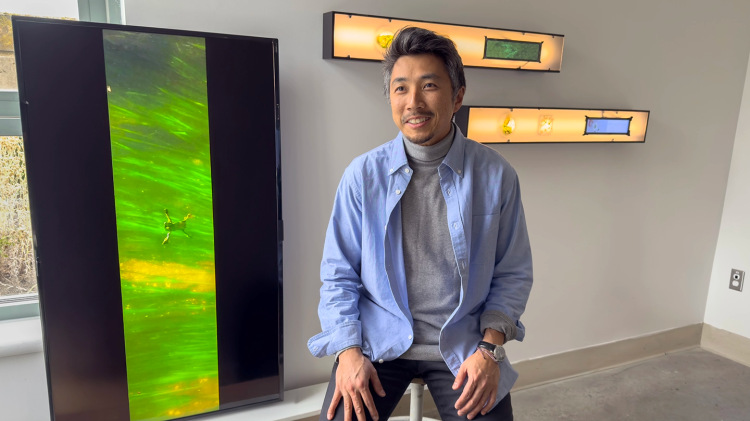
Joel Ong. Credit: John Threlfall
Connections to UVic research
Even before joining UVic's Faculty of Fine Arts, Ong was already engaged with Social Sciences and Humanities Research Council -funded interdisciplinary projects involving both Ocean Networks Canada (ONC) and the Climate Disaster Project.
"Creativity at UVic is quite profoundly universal, I think largely due to our proximity to research and Indigenous teachings on the environment, and the resulting common respect we have for nature," he says. "It's hard not to be inspired when you see the abundance of colours, forms, cycles and metabolic systems around us, and pay attention to the stories and histories embedded within them."
Ong sees his research into emergent digital art practices as an opportunity for both exploration and translation but one not without risk.
"I think the digital is another way to bring these stories to the foreground and to reveal what may be invisible or previously overlooked," he says. "But increasingly today this involves recognizing moments where wonder' has been used as an excuse for colonialization, extraction and exploitation, and the ways emergent digital technologies support these actions."
Creating through data visualization
Two of Ong's current installations neatly encapsulate his ideas. The ONC-engaged "Memory Machines #2: Ocean Memory" on view at the Canadian Cultural Centre in Paris until January 2026 focuses on recent explorations into the ocean using data visualization and sound composition.
"Sea kelp is a common occurrence on the shoreline here in Western Canada and, in its washed-up, dried-out form, is often an outlier in contemporary data portraits of the ocean," he explains. "In one experiment, we spent some time in the lab collecting and imaging kelp under the microscope, integrating those images with a custom algorithm to create a collaborative drawing."
Another video shows deep-sea machines doing maintenance on sensing instruments. "Affording this visuality/knowledge of the deep sea reveals the invisible labour behind statistical outliers such as (zero data) sets," he says. "This installation offers an entry point for us to continue engaging with the rich and contested notions of the coast, and an invitation for broader conversations."
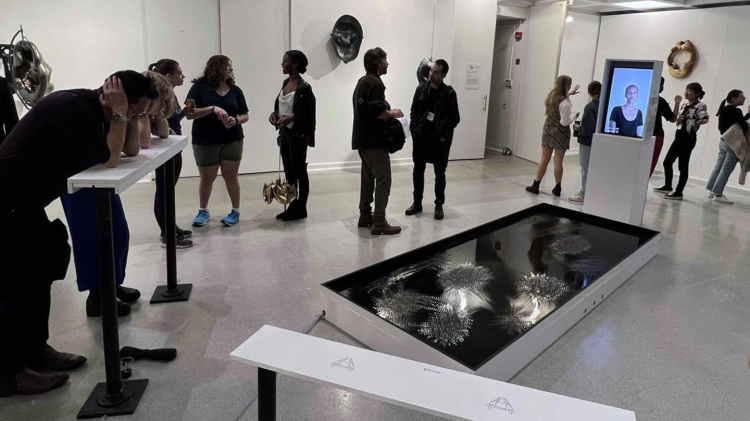
"In Silence" at the Ammerman Centre for Art & Technology. Visitors gain access to the narratives only through bone-conductance at one of two listening stations: patterning on the water is triggered by emotional densities in the narrative.
Similarly, "In Silence" seen in November at the University of Applied Arts in Vienna, and previously showcased at the Ammerman Center for Arts and Technology in conjunction with the Climate Disaster Project uses strategies in data visualization, computer vision and mechatronic elements to explore the expressiveness of water and its potential as a visualization tool for emotions that lie beneath the surface.
"This installation explores the translational and transdisciplinary poetics in our connection to water and its metaphors of flow, depth and revelation," he explains. "Visitors experience these stories through a prerecorded silent actor and vibration patterns in a reflecting pool nearby. The narratives could only be accessed through a bone-conductance panel. Uniquely, these metaphors are used to articulate the deep and often hidden emotional complexities facing individuals at medical, ecological and socio-cultural frontlines."
Part of an internationally engaged faculty
Ong is excited to now be working alongside the likes of Canada Excellence Research Chair Heather Igloliorte, Impact Chair Carey Newman and internationally recognized digital artists Kelly Richardson and Paul Walde, among his other new colleagues in visual arts.
"The faculty here is uniquely productive," he says. "It's a real honour to be in this department where everyone has a pronounced commitment to research-creation and socially responsive practices. I think learning in this context is mutually sustaining where the lines between artists and audiences, expert and amateur are blurred, and curiosity is shared. I'm very eager to learn from the well-established artists here and contribute to the growing expertise in digital arts."


