Many people dream of being in two places at once. For Francine McCarthy, that dream is about to become a (virtual) reality.
The Professor of Earth Sciences will talk to visitors at Milton's Crawford Lake at the same time she conducts her work at Brock University, located about 100 kilometres away.
But the Crawford Lake Francine McCarthy will live in a box a hologram box, to be exact.
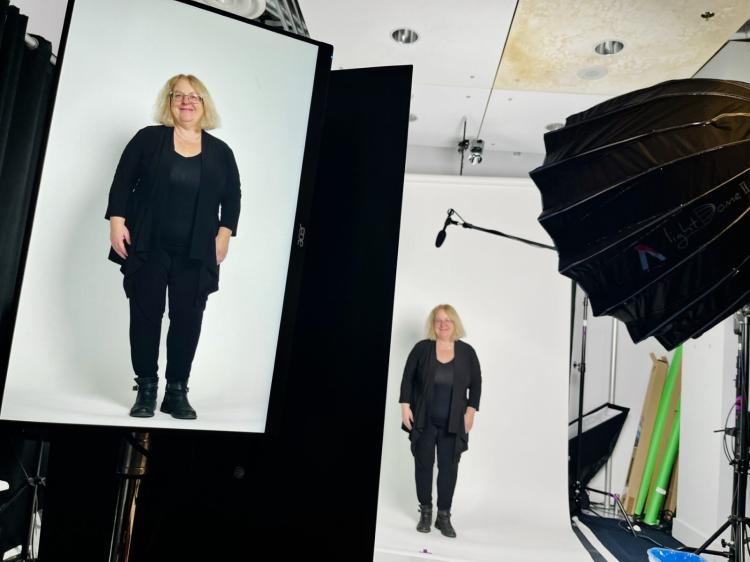
Professor of Earth Sciences Francine McCarthy will share her internationally acclaimed research with visitors to Crawford Lake in Milton, Ont., through a new hologram
McCarthy recently worked with a Toronto-based company to record answers to scripted questions about the unique lake and her work.
"It was an amazing opportunity to apply futuristic technology to communicating important 21st-century issues to a diverse audience," she says.
Her holographic image will soon be part of the renovated Visitor's Centre at the Crawford Lake Conservation Area, where she conducted her long-running research.
Trapped within the sediment cores she and her team extracted from the lakebed were traces of plutonium-239, fly ash and other anthropogenic markers of the mid-20th century.
Also found in the layers were cultigen pollen, including corn and sunflower, evidence of Indigenous cultivation activities spanning more than 500 years. This discovery led to excavations and the reconstruction of a 15th-century Longhouse Village.
The lake's geologic record of planetary-scale change is so clear that an international body of experts voted to identify Crawford Lake as the location that best shows the "golden spike," a marker that shows the boundary between the current Holocene and the proposed Anthropocene.
For the time being, though, Earth is still officially considered to be in the Holocene epoch.
Brenna Bartley, Manager of Education and Outreach at Conservation Halton, says she looks forward to McCarthy or rather, her holographic twin interacting with visitors.
"When we met Francine in person, we were impressed with her deep and personal knowledge of the sediment cores. Nothing really replaces having Francine interpret that core for you in person," Bartley says. "Our dream was to get Francine in front of our public on a regular basis, and with funding from the Government of Canada's Tourism Growth Program, we are now able to make that happen."
She says McCarthy's hologram box will be part of an art exhibit called The Spirit of the Lake. Scheduled to launch Sunday, Feb. 1, the exhibit will showcase artworks by four First Nations artists interpreting Crawford Lake.
Also in the exhibit will be a hologram of Leeanne Doxtator, Conservation Halton's Indigenous Education Co-ordinator.
"Leeanne is a remarkable educator," says Bartley. "We thought she'd be a really wonderful spokesperson to accurately and respectfully interpret the Indigenous history of the village at Crawford Lake."
For her part, McCarthy says what seems to be a novelty now will likely be par for the course in five years' time.
"Twenty-first century means of communication are much more interactive, making the participant part of the whole thing," she says. "They get to choose the questions; they don't just read a static thing that people have decided to tell them, they hear what they're interested in and aren't bothered with the rest."
McCarthy, who taught a science communications course in Brock's Earth and Planetary Science Communication program for the first time this year, says her image makes the science more accessible to the public.
"The scientist they get to see is not a stereotypic picture of a tall, bearded, European male scientist," she says. "I'm a short, chubby Canadian woman who is very good at communicating to people in a way they can understand without making them feel I'm talking down to them."
The Crawford Lake hologram display is the latest in a series of initiatives connecting the public with McCarthy and her research. Her team's work is also featured in the Royal Ontario Museum (ROM)'s year-long Crawford Lake: Layers in Time display, and the sediment core taken by her team proposed to define the Anthropocene as an epoch is now part of the Canadian Museum of Nature's permanent collection.
Among her many media and public appearances, McCarthy delivered a TEDx talk and spoke to the Pontifical Academy of Sciences at the Vatican about the proposed Anthropocene.