

Chemistry wasn't originally part of Divya Kaur Matta's career formula.
It was a subject she couldn't quite connect with, and she never quite knew why.
That changed, however, when she met educators who helped her realize the barrier wasn't chemistry itself, but how it was being taught.
"It's not that you hate chemistry, it's that no one has shown you how to understand it," says Matta, now a Brock University Assistant Professor of Chemistry, as she reflects on finding the path to her passion.
Matta has kept that lesson close at hand as she embarked on her own teaching journey and it has served her well.
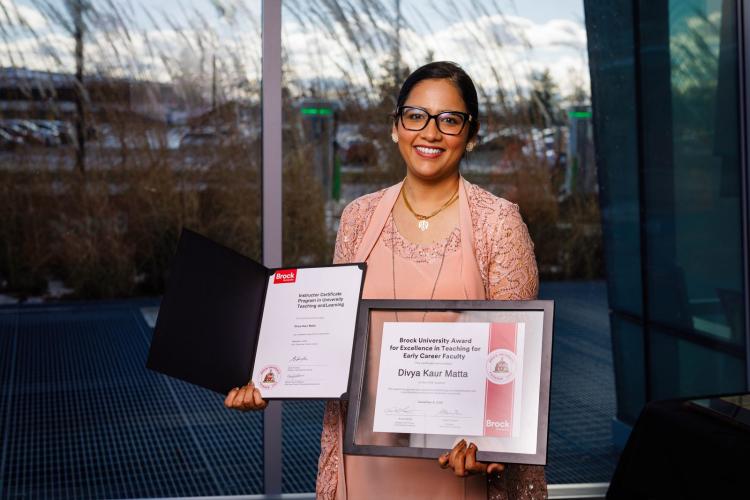
Divya Kaur Matta was honoured the 2025 Brock University Award for Excellence in Teaching for Early Career Faculty recipient during the annual Tribute to Teaching event on Thursday, Dec. 4.
Her efforts in the classroom saw her honoured with the University's 2025 Excellence in Teaching Award for Early Career Faculty during the Centre for Pedagogical Innovation's (CPI) Tribute to Teaching on Thursday, Dec. 4. The recognition pays tribute to
Matta's impact on student learning and her ability to shift students' attitudes toward chemistry.
"Every year, CPI is delighted to receive nominations for these awards that reflect the high calibre of teaching across campus," says Giulia Forsythe, CPI Director of Teaching and Learning.
Also honoured at Thursday's awards ceremony was Brock's 2025 Distinguished Teaching Award recipient Pauli Gardner, who delivered the event's keynote address, and 2025 Faculty Fellows in Accessibility: Shannon Welbourn and Christiana Okyere Folson.
In addition, CPI recognized and celebrated Instructor Certificate recipients, 2025 Faculty award recipients, 2025 TA Award recipients, Current Chancellor's Chairs for Teaching Excellence, 3M National Teaching Fellows, and all Brock Teaching Excellence, Distinguished Teaching and 3M recipients in attendance.
Since joining Brock as an Assistant Professor in 2022, Matta has seen many first-year students arrive feeling exactly as she once did: uneasy, overwhelmed or openly disinterested in the chemistry.
She views this not as a barrier, but as the beginning of a transformation.
"If students understand what you are presenting, they will want to learn more," she says.
Matta's teaching philosophy is grounded in clarity, compassion and evidence-based design.
She treats her classroom like a laboratory, aiming to diagnose where learners struggle, test new strategies and refine the design until students gain confidence. Her approach emphasizes adult-to-adult communication, clear expectations and learning materials that meet students where they are.
This approach, she says, helps students build confidence while reducing anxiety and encouraging genuine engagement with course concepts.
"When students feel respected and supported, their attitudes shift," she says.
To bridge gaps for students with limited science backgrounds, Matta incorporates videos, adaptive quizzes and real-world examples of chemistry in action to help demystify core concepts. Her classes demonstrate how chemical principles underpin everyday mechanisms and systems, making the subject more accessible and relevant.
Her goal is always the same: "I want students to carry durable curiosity, the courage to tackle unfamiliar problems and the confidence to say, I belong in science,'" she says.
Matta's research brings that same sense of curiosity and purpose. She uses computer simulations to study photosynthesis at the atomic level how the molecules in plants absorb sunlight and turn it into usable energy with remarkable efficiency. By understanding these processes in detail, her work helps inform solutions related to clean technologies, biofuels, crop resilience and climate change.
Beyond research, Matta collaborates with a colleague in the social sciences on initiatives to make science more accessible and inclusive. Her outreach includes mentoring high-school students, particularly young women and those underrepresented in STEM (science, technology, engineering and mathematics).
Her own journey fuels her empathy. Moving countries during her PhD brought intense culture shock and forced her to relearn academic norms, communication styles and classroom expectations.
That experience, she says, shaped her deeply student-centred approach: one rooted in belonging, patience and the belief that representation matters.
"Early exposure to approachable science changes trajectories," Matta says. "If someone sees a woman, an immigrant, a computational chemist teaching with clarity and joy, it quietly expands what they believe is possible for themselves."