Antimicrobial resistance is often described as a slow-moving tsunami. That image captures the urgency for Dr. John Conly, MD, professor in the Department of Medicine at the Cumming School of Medicine (CSM) and one of two directors of the University of Calgary's new World Health Organization Collaborating Centre.
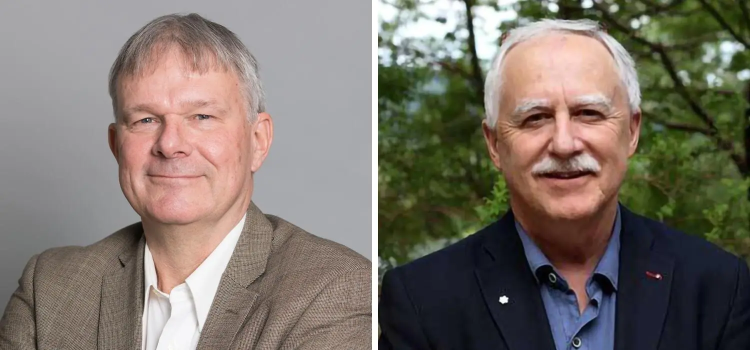
Herman Barkema, John Conly co-lead the PAHO/WHO Collaborating Centre for Research on Antimicrobial Resistance and Appropriate Use of Antimicrobials. Photo Courtesy Herman Barkema, John Conly
"A public health threat like COVID-19 comes about rapidly," says Conly, a member of the O'Brien Institute for Public Health and the Calvin, Phoebe and Joan Snyder Institute for Chronic Diseases at the CSM.
"Antimicrobial resistance is different. It builds slowly, like a wave gathering height and force far out at sea. But it is coming our way, and we need to be ready. If we can make a meaningful contribution from Calgary, we will feel we've done our part."
That contribution has just become global in scope. The Pan American Health Organization (PAHO) and World Health Organization (WHO) have designated One Health Research at UCalgary as a PAHO/WHO Collaborating Centre for Research on Antimicrobial Resistance and for Appropriate Use of Antimicrobials. The four-year designation runs from Aug. 18, 2025, to Aug. 17, 2029. Conly and Dr. Herman Barkema, DVM, PhD, will serve as co-directors.
It is one of only two WHO Collaborating Centres in Canada focused on antimicrobial resistance (AMR). The other, at York University, works on governance. The Collaborating Centre at UCalgary is the only one globally that includes the word "research" on antimicrobial resistance in its title.
"This centre is unique," says Barkema, a professor in the Faculty of Veterinary Medicine and the Department of Community Health Sciences at the CSM, and also member of the O'Brien Institute and the Snyder Institute for Chronic Diseases.
"Our Collaborating Centre will facilitate implementing the global research agenda on AMR and provide a focus on priority research directions for antimicrobial resistance and antimicrobial stewardship. That shows how strong our AMR research community is at the University of Calgary."
What the centre will focus on
As a Collaborating Centre, UCalgary researchers will support the PAHO and WHO in four major areas:
- Helping implement the WHO Global Research Agenda on antimicrobial resistance in human health. This includes monitoring progress, unpacking priority research questions and helping countries design studies that respond to WHO needs.
- Developing tools that connect antimicrobial use data from humans with data from animals and the environment. This allows countries to see how changes in one sector influence the others.
- Advancing digital tools and dashboards that feed antimicrobial use and resistance data back to prescribers in real time.
- Filling knowledge gaps in infection prevention and control, including hand hygiene, and contributing to WHO work to update guidance and build capacity.
"One of the reasons WHO was interested is that our team spans clinical infectious diseases, epidemiology, microbiology, implementation science, economics, law and policy," says Barkema.
"We can help turn the global research agenda into protocols, systematic reviews and tools that countries can use."
Their work will also build on existing UCalgary collaborations with the WHO. One major project is a series of systematic reviews on AMR across different organ systems, led jointly by Dr. Diego Nobrega, PhD'20, with colleagues at the University of Oxford in the U.K. and the Universitas Indonesia in Jakarta, Indonesia.
"We have 32 graduate students, postdocs and residents working on this right now," says Barkema. "It shows how international this work already is. Bugs do not stop at borders."
Canadian innovation with global reach
The Collaborating Centre will also help advance practical tools for stewardship. Conly helped develop the contents of an app that provides point-of-care optimal antibiotic guidance in Calgary and now supports the WHO AWaRe (Access, Watch, Reserve) Antibiotic Book. A related app for veterinarians, developed with the Canadian Veterinary Medical Association, provides species specific dosing recommendations.
"These tools are the cornerstone of stewardship efforts," says Barkema.
"We are rolling them out in Alberta primary care and veterinary practices. Training stewardship champions will help change prescribing behaviour in real time."
For Conly, Canadian innovation has an important role to play globally.
"We hope to see more Canadian ideas spread internationally, whether apps, research methods or new approaches to infection prevention."
A One Health foundation
Barkema has spent several years leading One Health at UCalgary and the AMR One Health Consortium. He sees the designation as a direct reflection of that institutional strength.
One Health is about collaboration and understanding that humans, animals and the environment are connected, says Barkema.
"If you have a boat with three holes and you only fix two of them, the boat still sinks," Barkema says. "You have to look at the whole system.
"We also need to remember the stakes. Antimicrobial resistant infections contribute to an estimated 14,000 deaths each year in Canada and the impacts are even more severe in lower and middle income countries. We have no choice but to act."
Barkema notes that UCalgary researchers are already working on AMR from many angles. This includes clinicians in the CSM, veterinarians in the Faculty of Veterinary Medicine, and researchers in engineering, science, nursing and law. Many are connected through the O'Brien Institute, the Snyder Institute for Chronic Diseases and other UCalgary entities.
"This centre brings those people together and connects them to WHO, PAHO and global partners," he says.
Nearly a decade of work
The foundation for this designation began almost 10 years ago. Conly spent a sabbatical at WHO headquarters in Geneva in 2010 and 2011, which created early ties with the team working on antimicrobial resistance. In 2017, he co-chaired a Canadian Academy of Health Sciences forum on antimicrobial resistance in Ottawa and invited Dr. Marc Sprenger, MD, PhD, then leading the WHO AMR secretariat.
The meeting reinforced the need for a national and global One Health strategy and marked the first conversations about a potential WHO Collaborating Centre in Calgary.
"The recommendations from that meeting still ring true," says Conly. "Canada has a responsibility to be a global leader on antimicrobial resistance. We need One Health approaches, better evidence and new solutions. It is gratifying to see that work come to life in this designation."
Strengthening UCalgary's global partnerships
"Antimicrobial resistance is one of the defining challenges of our times, and having the University of Calgary recognized as a WHO Collaborating Centre affirms that the innovative research happening here is shaping international solutions," says Dr. William Ghali, MD, vice-president (research) at UCalgary. "These efforts bridge disciplines, bring together world-class researchers, and tackle AMR with the urgency and collaborative spirit it requires."
Conly and Barkema hope the new collaboration will help slow the rising tide of antimicrobial resistance.
"Humans, animals and the environments we share are all connected," says Conly. "If this Collaborating Centre can help reduce inappropriate antimicrobial use and strengthen stewardship across sectors, that will be a legacy worth having."
The PAHO/WHO Collaborating Centre is planning a launch event on Jan. 8 from 4-6 p.m. you can register here.