

A Western spinoff company is poised to overhaul how pathologists search for lymph nodes in cancerous tissue samples, solving a critical diagnostic problem worldwide.
"In 2021, we built our first rough prototype to improve colon cancer care. Now, we're aiming for a commercial launch of our Lymphonator' in Canada by 2027. Getting to this point has been a wild ride," said Saumik Biswas, PhD'20, CEO and co-founder of Tenomix.
Within four years, the startup refined an innovative, robotic benchtop imaging device, secured millions of dollars in investment and received federal funding to begin testing in at least two Canadian hospitals, including London Health Sciences Centre's University Hospital.
How does academic inquiry turn into a potentially life-saving business enterprise in such short order?
"Mostly through perspiration. Building a startup is hard work. Fortunately, we also had a strong relationship with the Technology Transfer Office to support us along the way," Biswas said.
Western's Technology Transfer Office is the university's business development arm that helps researchers navigate commercialization, the complex process of bringing innovations to market, whether through partnerships with industry, spinoff companies or licensing agreements.
"We guide researchers on the best path forward based on what they want to do," said Sarah Brooks, associate director of new ventures in the Technology Transfer Office. "We can help researchers find commercial potential they may not initially see for their lab innovations."
Technology Transfer Office connects research to practical applications
The Technology Transfer Office is one of three teams within Western Research driving innovation, alongside Western Research Parks and Strategic Partnerships. The office also supports London Health Sciences Centre Research Institute (LHSCRI) and Lawson Research Institute (Lawson) at St. Joseph's Health Care London in translating research discoveries to real-world applications.
"Our researchers are developing products and technologies that have the potential to improve lives in Canada and around the world. Western's innovation ecosystem, including the Technology Transfer Office, helps breathe life into these discoveries by providing the support and resources needed to move ideas from campus to market," said Penny Pexman, vice-president (research)."
Additionally, the office identifies possible industries, market size and potential partners.
"We're a concierge for researchers, connecting them to the right resources to commercialize their innovations in a way that best suits them," Brooks said.
"We want our research commercialized, we want it scaled and we want it built in Canada as much as possible. We reach out to the right partners and network strategically to put our researchers forward for funding and connect them with go-to-market mentors." - Sarah Brooks, associate director of new ventures, Western's Technology Transfer Office
In 2025, commercialization of Western innovations brought $6.7 million in license revenue to the university. Ten new patents were issued.
Tenomix is one example of an innovative solution nurtured from early curiosity to real-world offering through Western's range of entrepreneurial and commercialization supports.
"Support from Morrissette Institute for Entrepreneurship and Ivey helped strengthen our business foundation, and the faculty at Schulich Medicine, along with imaging scientists at Robarts, provided invaluable technical guidance as we translated our research into a viable product," Biswas said.
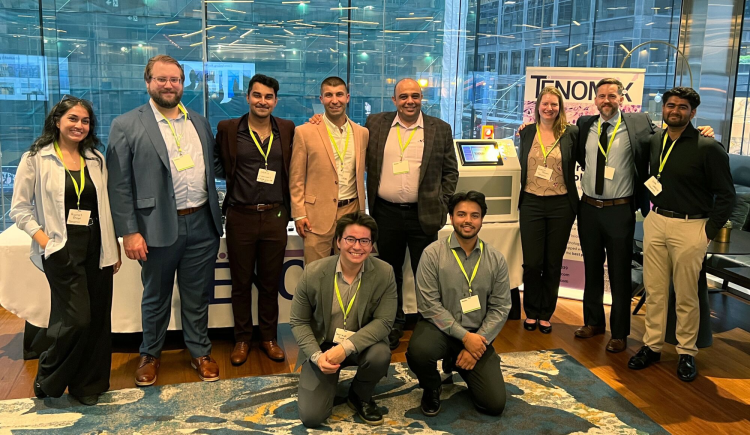
The Tenomix team includes (L to R) Rupreet Bhogal, Jacob Tryon, Saumik Biswas, Mike Lavdas, Sherif Abdou, the Lymphonator' robotic scanner, Eveline Pasman, Jamie Tremaine, Guha Ganesh, (Front) Santiago Plata Salazar and Ketan Vashisht. (Submitted)
The company's early successes at pitch competitions run by Morrissette Entrepreneurship led to a pivotal connection with a Western alum who went on to become one of its major early investors and a long-term partner.
Biswas met his co-founders, Western grad Michael Lavdas (CTO), BESc'18, MESc'20, Eveline Pasman (COO) and Sherif Abdou (CBO) in 2020, through a fellowship supported by the Tech Transfer Office.
"In less than a year, we interviewed hundreds of clinicians worldwide to figure out their pain points," he said. "The Medical Innovation Fellowship program helped fuel the mindset that we really had to understand a problem thoroughly before developing a solution."
Tenomix tackles diagnostics with AI-powered technology
The Tenomix team focused on a diagnostic process many would be surprised to learn is still done by hand - the detection of lymph nodes in colon cancer tissue.
"Pathology staff across Canada, the U.S., Middle East, Europe and Asia all said the same thing - searching for lymph nodes by hand is difficult, time consuming and unreliable, especially in patients who received chemotherapy to shrink their tumors prior to surgery," Biswas said.
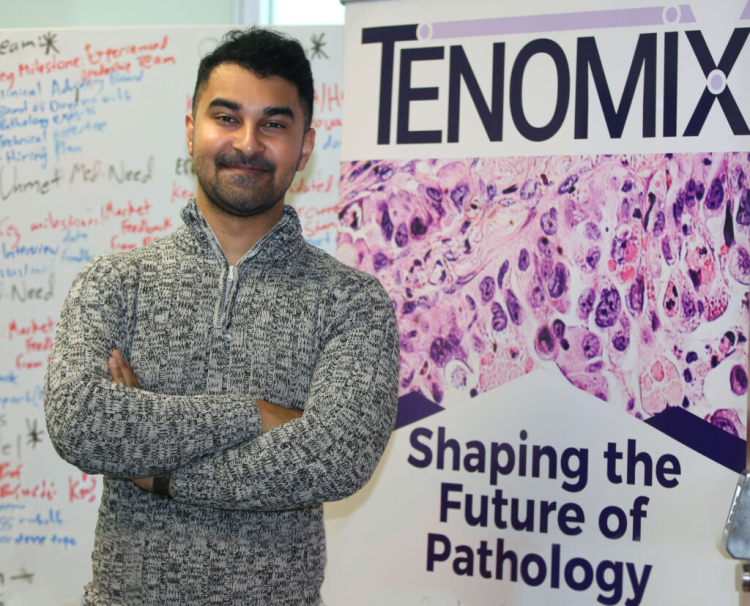
Saumik Biswas, CEO of Tenomix, is preparing for clinical testing of the company's robotic, AI-powered scanner in two Canadian hospitals. (Colleen MacDonald/Western News)
A study co-authored by Biswas confirms the scale of the problem, with the Mayo Clinic in Rochester, Minn., reporting an average error rate of about 50 per cent per case. Accurate lymph node retrieval is critical for determining whether cancer has spread and to plan the course of treatment. It also makes cancer diagnostics more cost-efficient by reducing unnecessary further testing of false positive results.
The most consequential inaccuracy occurs with false negatives, Biswas said.
"When cancer-positive lymph nodes are missed, it can really skew the cancer staging of a patient. It could be the difference between getting chemotherapy or not," he said.
To detect lymph nodes more accurately and efficiently, the team designed an imaging device that fuses robotics, ultrasound and AI - code-named the Lymphonator. They developed their early prototypes at BioNext, Western's incubator for medical innovations.
"BioNext provided the resources we needed for prototyping and development, which allowed us to reallocate those costs toward hiring the right software and hardware engineers. It freed up funds we would have otherwise spent on rent, helping us scale much faster."
Collaborating with London Health Sciences Centre to advance diagnostics
A collaboration with the Department of Pathology and Laboratory Medicine (PaLM) at LHSCRI proved key for accelerating the growth of Tenomix. The team received ethics approvals to work with principal investigators in the pathology lab to test human tissues. That testing informed each iteration of the Lymphonator and ensured its real-world relevance.
"Medical startups without access to those tissue specimens might use phantom models or non-realistic benchtop testing, and then after years of development, they could find their technology doesn't work in real clinical settings," Biswas said.
That's why the company's work with industry and hospital networks has been so valuable. The tissue-testing project is led by Dr. Matthew Cecchini, a pathologist at LHSC, associate scientist at LHSCRI and professor at Schulich School of Medicine & Dentistry.
"Research hospitals are the proving ground where promising technology becomes clinical reality. Partnering with Tenomix to test the Lymphonator at LHSC lets us validate its performance where it matters most, on real patient specimens, with real clinical workflows," said Cecchini, the principal investigator.
Tenomix also collaborates with LHSC and several other Canadian and American hospitals to collect standardized image datasets for AI training.
"The algorithm is so powerful it can detect small structures that are nearly impossible to detect by hand or eye. Today, our platform is finding lymph nodes, but in the future, it could support a range of other tissue identification applications - the opportunities are truly endless," Biswas said.
While Western owns the patent for the Lymphonator, Tenomix negotiated a license agreement that gives the company exclusive use.
"The Tech Transfer Office wants to see us win. We got competitive, founder-friendly terms on our licensing, and our agreement gives us the option to buy out the patent in the future." - Saumik Biswas, CEO of Tenomix
Brooks said commercialization at Western is inventor-led, with the Technology Transfer Office handling the administrative work including sales, marketing and managing the intricacies of contracts.
"We do a lot of heavy lifting, such as ensuring entrepreneurs understand the complexity of contract language. There's often a lot of back and forth before we even get to the contract stage," she said.
Technology transfer leads to commercialization successes
Commercialization at Western has decades of history, with some outstanding successes. The CT perfusion technology developed by Western medical biophysics professor and Lawson scientist Ting-Yim Lee transformed stroke diagnosis through high-resolution imaging of blood flow in the brain. Since its licensing in 1999, the technology has been adopted by more than 8,000 hospitals globally, with the number of licences sold surpassing 25,000.
The Desired Sensation Level (DSL) audiology technology, originally led by Richard Seewald, DSc'17, professor emeritus in the School of Communication Sciences and Disorders, was the first pediatric hearing aid prescription software. The technology, now licensed by more than 20 manufacturers worldwide, is embedded in fitting software to help audiologists create customized sound prescriptions for infants, children and adults who use hearing aids.
Together, these technologies have returned tens of millions of dollars to Western in licensing fees since the early 1990s, with revenue from Lee's work split with Lawson, LHSCRI and Lee.
Tenomix is on track to emerge as another success. The company was selected for the Innovative Solutions Canada testing stream, a federal program funding the testing of its technology in at least two Canadian hospitals in 2026.
"Interconnected support across Western has been essential in turning our early lab innovation into a venture-ready company preparing for clinical testing," Biswas said.
As the company's momentum grows, the Tech Transfer Office is expanding its suite of resources to provide a path for innovators.
"Every innovation can have a different journey," Brooks said. "Being dialed in to the right resources ensures researchers don't miss opportunities that could lead to lasting impact in the world."