


The Arctic is warming nearly four times the rate of the rest of the planet altering Indigenous ways of life in the far north. Shorter winters, thinning sea ice, vegetation change and shifting wildlife distributions have been recorded by Indigenous hunters and land users across the Arctic.
Last month, the University of Victoria (UVic) Arctic Landscape Ecology Lab and the Gwich'in Tribal Council's Department of Culture and Heritage, received the Frederik Paulsen Arctic Academic Action Award to support their work on climate change impacts on Gwich'in lands and waters. Their project, Nan guk'anàatii ejuk t'igwinjik (The land we are taking care of is changing) won the prestigious international award worth 100,000 euros.
Trevor Lantz leads UVic's Arctic Landscape Ecology Lab in the School of Environmental Studies, where team members have been working for fifteen years to understand northern landscape change.
We submitted a video application to the UArctic and Arctic Circle (both jointly administer the Frederik Paulsen award) highlighting our work with the Gwich'in Tribal Council's Department of Culture and Heritage to understand how climate change is impacting Gwich'in ways of life. We are extremely honoured to receive the Frederik Paulsen Award and excited by the support it will provide for collaboration with our research partners in the Northwest Territories."
Trevor Lantz, environmental studies professor
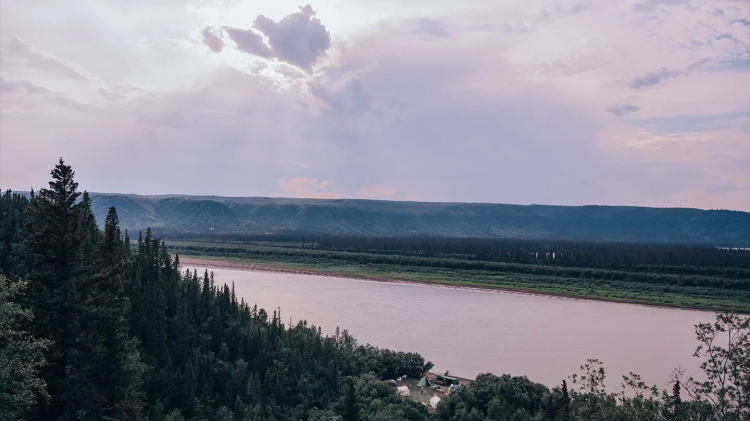
Dèeddhoo Gòonlii, found along the Teetł'it Gwinjik (Peel River), is an area named after a hill at whose base rocks can be found in the shape of scrapers. This area is host to a few fish camps where during the summer, people often spend time fishing for the running łuk dagaii (whitefish) and shruh (coney). Credit: Aryln Charlie.
"Our lab has produced spatial inventories of disturbances like permafrost thaw and tundra fire and developed novel methods to predict landscape sensitivity to these disruptions," says Lantz.
The combined effects of changing disturbance regimes and climate-warming are rapidly transforming landscapes across the Arctic. These changes are impacting Gwich'in ways of life by altering the abundance of key foods and impeding access to land-based traditions.
Lantz and UVic Research Associate Tracey Proverbs along with Gwich'in Tribal Council's Department of Culture and Heritage will use the Frederik Paulsen Award to collaborate with Gwich'in knowledge holders on solutions that will support community adaptation.
"What excites me the most about the award is the opportunity to continue working in relationship with the Gwich'in Tribal Council's Department of Culture and Heritage," says Proverbs.
"This northern Indigenous nation has had an intricate, robust and resilient relationship with their lands, since time immemorial," adds Proverbs.
"Gwich'in knowledge, in combination with scientific methods, provides an unparalleled way to understand the rapid, unprecedented changes occurring across multiple spatial scales, with lessons that can be shared with other groups and decision makers across the circumpolar north and even further abroad," says Proverbs.
Arlyn Charlie is the culture and heritage coordinator with the Gwich'in Tribal Council's Department of Culture and Heritage and an undergraduate student at UVic. He has collaborated with UVic's Arctic Landscape Ecology Lab on several projects over the years. Charlie is Teetł'it Gwich'in and has grown up on the land and witnessed the rapid changes and the impact on his community.
The Porcupine Caribou normally arrive late in the fall and overwinter in the area. For two winters now, the caribou have not come."
Arlyn Charlie, Gwich'in Tribal Council's Department of Culture and Heritage
Charlie explains that the loss of permafrost and vegetation change have disrupted the migration of the Porcupine Caribou; his community must adapt to hunting a different food source, such as moose. Fishing is also being impacted says Charlie as conditions in rivers and lakes change.
"The land is falling in on itself as the permafrost melts; a flood in 2023 swept away my grandfather's camp, a fish camp my family used for generations. Personally, there was a lot of anger and frustration after the flood," says Charlie.
The anger is for losses beyond Gwich'in's control their land is changing, and their way of life is being threatened by outside forces and climate change. Deep spiritual connections to the land have guided Gwich'in culture for generations which is reflected in the over 800 place names, oral history and knowledge linked to traditional use of their lands.
Lantz, Proverbs and Charlie are working with a larger team to bring together Gwich'in knowledge and scientific modelling to create maps that predict climate change impacts, inform decision-making and adaptation planning and will form a model approach which can be applied broadly across the Arctic.
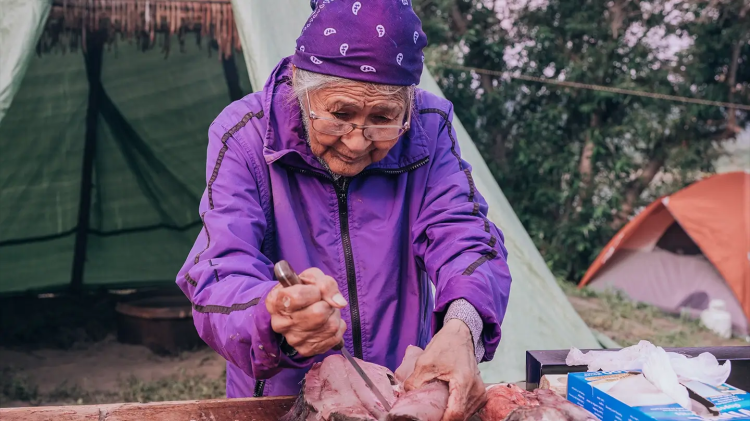
Gwich'in Elder Joanne Snowshoe making uutsik (dry fish) at Dèeddhoo Gòonlii. This camp was hosted by the Department of Culture and Heritage as part of their project: Confronting Climate Change on the "Big River" Nagwichoonjik. Credit: Arlyn Charlie.
"Our work will bring together Gwich'in knowledge of habitat and land-based traditions, with models predicting the impacts of climate-driven disturbances on the distribution and abundance of culturally important species," says Lantz. "Our long-term goal is to create a fluid and multi-layered overlay of the entire Gwich'in Settlement Region that can be used by Gwich'in organizations to make decisions."
Everything is changing faster in the Arctic but the Gwich'in are adapting. By bringing together scientific knowledge with Gwich'in Knowledge of habitat, harvesting areas, travel routes and important places with estimates of landscape change, Gwich'in land users will be able to make vital decisions about adaptation planning choices.
As Charlie explains, "we are deeply connected to the land Gwich'in elders continue to teach youth our traditional ways of fishing, plant harvesting and hunting."
"The Gwich'in are resilient and adaptive," says Charlie. "Our culture will continue to survive, 50 years to 100 years from now."
The Frederik Paulsen Arctic Academic Action Award provides high-level recognition for innovative ideas that aspire to transform knowledge into action to help address the causes and impacts of climate change in the Arctic.