For Jessica Blythe, Associate Professor in Brock University's Environmental Sustainability Research Centre, equity is the key to supporting ocean sustainability.

Associate Professor Jessica Blythe in Brock University's Environmental Sustainability Research Centre is the lead author on a new paper in Nature launching the Ocean Equity Index, a free tool for assessing ocean-based projects and policies
Growing inequity in ocean-based activities has seen corporations benefit from ocean industries, such as offshore drilling and deep-sea mining, while coastal communities and marginalized people experience negative effects such as pollution and displacement.
While equitable governance has been built into several global initiatives like the United Nations' Sustainable Development Goals, Blythe says there was no universally agreed-upon way to measure it until now.
Together with an international team of researchers and practitioners, Blythe has developed a free tool for measuring equity in ocean-based projects and policies called the Ocean Equity Index (OEI), as described in a new paper in Nature.
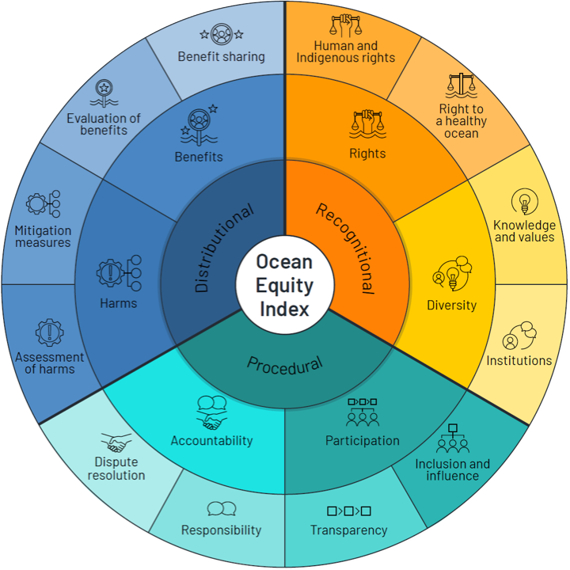
The conceptual framework of the Ocean Equity Index shows the 12 scoring criteria in the outer ring.
"With new global agreements, like the High Seas Treaty and the Kunming-Montreal Global Biodiversity framework, there are voluntary and legal requirements for oceans to be equitably governed," says Blythe. "But when our team talked to people working in this space, there was little guidance on how to fulfil those commitments. If we're not taking action towards equity, we're not going to see improved outcomes."
Whether used as a planning tool for proposed projects or as part of an adaptive management strategy, the OEI is designed to be highly adaptable and user-friendly at any stage.
Assessments, which can be completed within hours by individuals or groups, generate a numerical score and recommended actions that can be reassessed at regular intervals to monitor progress over time.
"These characteristics of the tool are intentional to facilitate uptake in different contexts," says Blythe. "It can be adopted in the global policy sphere and incorporated into ongoing monitoring and evaluation by companies or by governments at different scales.
Of particular interest, Blythe says, is coastal communities "whose rights are being violated and whose resources are being co-opted."
"We're hopeful that the OEI can be a tool of resistance for those groups."
The OEI was developed over the course of three years by the Blue Justice Working Group, for which Blythe serves as co-Principal Investigator. Through extensive consultations and workshops, the team whittled down a list of 150 possible indicators to the 12 criteria seen in the final version. Early test versions were trialled by partners across the ocean sector, and around the world, to obtain feedback.
The result is a resource that can be used across industries and in different cultural contexts.
With the United States' recent withdrawal of both commitment and funding from several global environmental agreements, Blythe says the need for an effective and free tool is especially important.
"In order to realize better social and ecological outcomes in our oceans, we need to be able to take action where equity is lacking," she says. "The tool facilitates better outcomes for groups impacted by ocean initiatives through involving them more, making sure their voices are heard and making sure benefits are shared equally."