The University of the Fraser Valley's top-notch nursing program is taking another step forward with the introduction of a Nursing Faculty Development program. With $453,340 in funding from B.C.'s Ministry of Post Secondary Education and Future Skills, the program will roll out in stages over the next four years, supporting new hires as they move from expert clinicians to educators in the classroom.
"Strengthening the teaching skills of clinical nurses is essential to preparing the next generation of health-care professionals," said Jessie Sunner, Minister of Post-Secondary Education and Future Skills. "When experienced nurses receive the support they need to become effective educators, they can pass their knowledge on with confidence, ensuring that new nurses enter the workforce prepared, ready to practice, and ready to serve the community."
New instructors in the UFV nursing programs are highly knowledgeable in their field, but classroom and clinical teaching is often unlike anything they've experienced before.
"Transitioning from bedside nurse to educator can include a steep learning curve, because the world of post-secondary education requires a different skill set," says Cindy Schultz, associate dean of the Faculty of Health Sciences. "We've been looking at ways to better support new faculty so they can better support students."
Over the last three years, faculty member Janelle Baerg has done great work providing startup education for new instructors in what Cindy describes as a summer intensive.'
This program builds on her efforts, adding elements of ongoing support.
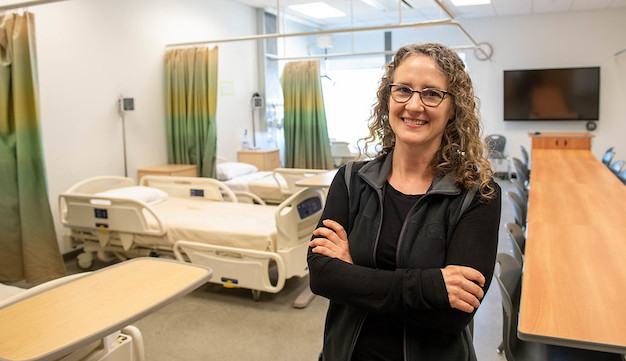
Dr. Lee-Anne Stephen.
Three experienced BSN nursing faculty, Rona Miller, Lorelei Janzen and Sarah Johanson, are now developing interactive learning modules, on campus workshops and clinical support strategies. Additional items to be developed include on-campus simulations of clinical scenarios to help new faculty manage difficult situations, and guidelines and best practices will be created for team teaching.
A classroom teaching component will include training on how to create and administer exams, assignments, and course syllabuses, and how to effectively manage challenges that inevitably come up in the classroom and clinical setting.
"Learning how to engage students in the classroom is essential," says Lee-Anne Stephen, director of UFV's School of Health Studies. "The learners of today want and expect more than a teacher standing at the front of the room with a PowerPoint presentation.
"Supporting students so they can safely practice in the clinical setting is also challenging. One needs to balance patient and student safety with student learning."
It can be difficult, Lee-Anne says, for new faculty to transition from being an expert in nursing to being a novice in teaching, and we don't want new faculty to feel overwhelmed.
"We're trying to be very intentional about giving people what they need in the moment, starting out with information that they need in the short term," she explains. "Then we build onto that rather than giving them the information all at once."
Cindy says UFV's mentorship program will be shared with institutions across the province.
"As nursing education continues to change, nurse educators need to work together to support one another. We all want the same result, which is making sure our graduates, regardless of which institute they come from, have the knowledge and skill to provide safe and competent patient care."
Ultimately, Cindy believes the new faculty will become mentors in the future.
"If they've received good support, I'd love to see them offering that same support to our new faculty."
For more information

33844 King Road
Abbotsford British Columbia
Canada V2S 7M8
www.ufv.ca/