

A federal research grant gives CapU kinesiology students hands-on experience that goes beyond the classroom and demonstrates the impact of applied research.
Repetitive head impacts (RHIs) - minor but repeated blows or jolts to the head - are an underrecognized risk in contact sports. Unlike concussions, which often receive immediate medical attention, RHIs can accumulate silently over time, potentially leading to long-term cognitive and mental health issues.
Studies show that a significant percentage of junior hockey players experience RHIs during a season, highlighting the urgent need for research and prevention strategies.
CapU's RESILIENCE Project (Research Effects for Sport and Life in Electroencephalography Neurological measurements at Capilano University EEG testing) aims to address this gap.
This work is possible thanks to CapU's first-ever Applied Research Tools and Instruments (ARTI) grant from the Natural Sciences and Engineering Research Council of Canada (NSERC), in collaboration with the Canadian Institutes of Health Research. The $151,200 award funded the purchase of the NeuroCatch Platform, enabling CapU to expand its capacity for brain health and resilience research in high-performance sports.
Led by kinesiology instructor Donna Perry, the project focuses on hockey players, tracking their brain function over time - from pre-season to post-season and recovery - using the NeuroCatch Platform, an innovative EEG device developed by B.C.-based medical technology company HealthTech Connex.
The research team trained on the equipment with CapU Blues student-athletes in August, before conducting baseline EEG testing on male and female hockey players ages 16-20 this past fall.
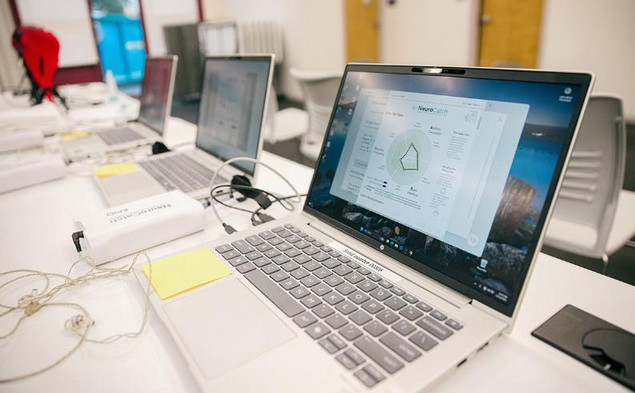
The NeuroCatch medical device platform is designed to quickly measure cognitive function using electroencephalography (EEG).
"Through the RESILIENCE Project, we're breaking new ground by studying brain function, resilience, and mental health in hockey players across an entire season," says Perry.
"This research is vital for further understanding athlete safety and recovery - and thanks to NSERC funding, our students gain hands-on experience with cutting-edge EEG technology, preparing them for careers in sport science and health."
Quick facts
- Grant: $151,200 from NSERC ARTI program
- Equipment: NeuroCatch Platform (Health Canada-approved EEG tool)
- Project: RESILIENCE - Research Effects for Sport and Life in Electroencephalography, Neurological measurements at Capilano University EEG testing
- Why it matters: Sports account for 44 per cent of traumatic brain injuries among Canadian youth aged 5-19, with ice hockey contributing to roughly one-quarter of those cases in males and one-third in females
- Student benefit: Hands-on research experience, advanced neurophysiology skills, career-ready training
For kinesiology students, the impact is immediate.
"Seeing the NeuroCatch device come to CapU and being part of the RESILIENCE Project has been such a wonderful experience," says student research assistant Chelsea Watson.
"It's incredibly meaningful to work on a project rooted in passion and to bring awareness to athletes about brain health. These hands-on opportunities go beyond the classroom and remind me how impactful applied research can be."
- Chelsea Watson, student research assistant
CapU is the first post-secondary institution in B.C. to gain access to this portable "brain lab," specifically designed for applied research and point-of-care assessment.
The technology provides immediate reports on three critical brain responses - auditory sensation, basic attention and cognitive processing - within seconds of a six-minute cognitive test.
For more information

2055 Purcell Way
North Vancouver British Columbia
Canada V7J 3H5
www.capilanou.ca/