When you think of climate change impacts, you may think of melting Arctic ice. But as the ice in the Arctic shrinks, wildlife in the region is facing a noisier environment, which is especially problematic for sound-sensitive marine life.
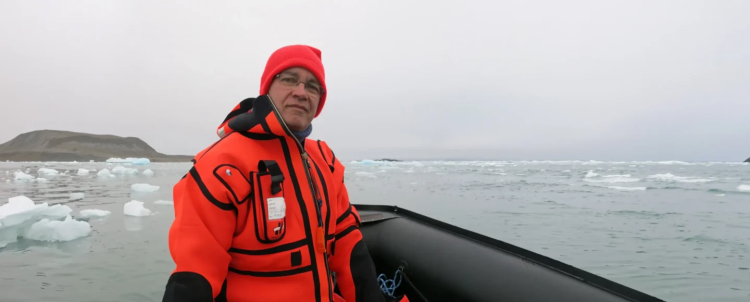
Philippe Blondel collecting hydrophone measurements in an ice-laden fjord deep in Svalbard, 2014. Credit: Prof. Jaroslaw Tegowski, University of Gdansk.
As ice recedes, creating new transport passages for shipping, cruise ship activity and mining and drilling, human marine activity noise also grows. This audible volume increase is significant for everyone that calls this area home, from the whales to the tiny crab larvae. Noise disturbances can impact their feeding, navigation and socialization practices. With these broader impacts in mind, scientists are exploring ways to set evidence-based guidelines for acoustic limits.
Thanks to a decade of hydrophone data from the Ocean Networks Canada (ONC) coastal community observatory at Cambridge Bay, Nunavut, researchers are better able to determine a baseline for subsea noise levels from human activity. Philippe Blondel, a senior lecturer in the Department of Physics at the University of Bath, led a research team in analyzing this data, looking at variances of underwater sounds in May and August, where both ice coverage and human marine activity differed. Noise levels from overhead aircraft and coastal land use were also included in the study published in the Nature journal NPJ Acoustics.
"Because the Arctic is melting and is changing nearly four times faster than anywhere else on the planet, it affects the ecosystem, it affects the animals that live there," says Lyne Morissette, a Quebec-based marine biologist who serves on the ONC board of directors. "And we need as much data and knowledge as possible to better understand it because it's changing fast."
Read more about the study published on Ocean Networks Canada, which includes more insights from an ONC acoustic specialist and senior scientist.