There is no one-size-fits-all approach to treating relapses of cancer after therapy, but new research led by the University of Calgary in multiple myeloma could lead to the development of personalized, next-generation treatments to prevent relapses in not only the second most common blood cancer in adults, but possibly other forms of the disease.
The study, led by members of the Arnie Charbonneau Cancer Institute and published in Nature Medicine, takes a closer look at why multiple myeloma patients often relapse after undergoing immunotherapy by studying how myeloma cells adapt to treatment. By understanding how the cancer builds resistance, future treatments can be designed to take this into account, with the goal of preventing another relapse.
Multiple myeloma is the second most common blood cancer in adults. It starts in the white blood cells that are responsible for creating antibodies that help the body fight infections. Once the myeloma cells begin to multiply, it makes it harder for the blood cells to function properly. There are effective treatments, including immunotherapies that can significantly extend survival; however, in some, the cancer cells become treatment resistant.
"Multiple myeloma tumour cells are highly adaptable under therapeutic pressure," says Dr. Holly Lee, MD, PhD'25, a clinical assistant professor at the Cumming School of Medicine and first author on the study. "A treatment could be incredibly effective, bringing disease bulk down from about 100 per cent to about one to two per cent but all it took was that one to two per cent of the cells that were left to adapt and cause this relapse in patients."
Gaining an understanding to create better treatments
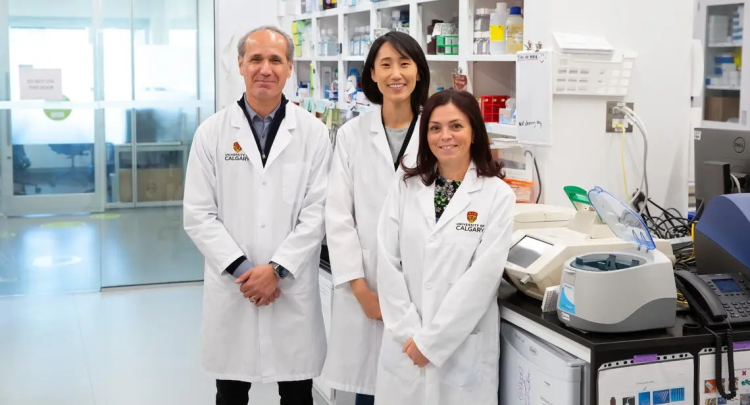
From left: Nizar Bahlis, Holly Lee, Paola Neri. Photo Credit: Riley Brandt, University of Calgary
Lee, alongside project leads Dr. Paola Neri, MD, PhD, and Dr. Nizar Bahlis, MD, assessed data gathered from clinics across North America, Europe and Asia. They looked at the tumour cells of patients who relapsed after having gone through a form of immunotherapy, bispecific T-cell engager, so they could better understand why the cancer was becoming resistant to treatment over time. This therapy helps the immune system identify and attack the multiple myeloma cancer cells by targeting a protein on the tumour cell called GPRC5D; the protein sits on the surface of the myeloma cell.
The researchers found the tumour cells adapted in multiple ways.
Lee says understanding these different adaptations can guide the development of next-generation treatments, designed to anticipate and overcome these changes.
"Immunotherapy is quite an active topic when it comes to myeloma research because it's really changing how we practice in our clinics and what we're able to offer to patients," says Lee. "For us to really cure myeloma, we have to understand the tumour cells and develop treatments to stay ahead of them building that resistance."
Researchers also found that it is quite common for the tumour cell to go through some form of protein mutation. About 60-70 per cent of relapsed patients studied relapsed because of the myeloma cell protein adapting.
Study contributes to a larger picture: Personalized, individual cancer therapy
The research highlights that treatment can not be a "one-size-fits-all" approach. Researchers add the findings don't just relate to multiple myeloma, but have the potential to apply to other cancers.
"Cancer is not one disease," says Lee. "Each cancer and each patient behave very, very differently. We have patients who are in remission for four or five years and others who relapse within six months after receiving the same therapy. I think this paper and this study is a step towards personalized cancer therapy."
The goal moving forward is to implement more targeted screening within clinical practices with a quicker turnaround time to better support the treatment process for patients in real time.
Research made possible by international collaboration
Lee says that, by openly sharing their findings over the years, they started to realize other researchers and clinicians were seeing similar patterns in their work, opening a conversation that eventually led to this international collaboration.
"The true incidence of this type of biological adaptation in GPRC5D was unknown in the field. In order to generate enough data to support the research, it required a collaborative effort," says Lee.
This study was supported by the Multiple Myeloma Research Foundation, Leukemia & Lymphoma Society of Canada, International Myeloma Society, Paula and Rodger Riney Foundation, Blood Cancer United, and the Terry Fox Foundation Marathon of Hope Cancer Centre Networks.
Holly Lee, Paola Neri and Nizar Bahlis are part of the Riddell Centre for Cancer Immunotherapy at the University of Calgary.
Holly Lee is a clinical assistant professor with the Department of Medicine at the Cumming School of Medicine (CSM) and member of the CSM's Arnie Charbonneau Cancer Institute. She is a specialist in multiple myeloma biology and novel immunotherapy development.