Feeding local wildlife might seem harmless, but Kiyoko Gotando's research shows small everyday actions can have profound ecological impacts.
While conducting research in the Galapagos Islands, the Brock University Assistant Professor of Biological Sciences observed that Darwin's finches seemed to prefer eating human foods rather than those they have evolved to consume.
Gotanda and her team designed a unique method of collecting fecal samples to investigate the impacts of this new diet on the birds.
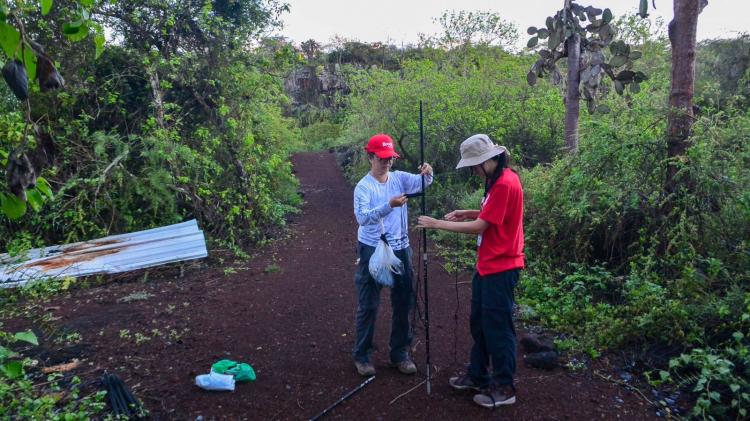
Assistant Professor of Biological Sciences Kiyoko Gotanda (left) has received Brock University's 2026 Early Career Research and Creative Activity Award for her impactful scholarship, which includes fieldwork conducted in the Galapagos Islands with Paige Au (BSc '25).
"We found that the human foods change the Darwin's finches' gut microbiome which could influence their immune function and ability to defend against parasites, among other things," she says.
The project is part of Gotanda's laboratory, which studies how organisms evolve in natural ecosystems and urban environments, particularly when adapting to changes brought about by humans.
That work has earned her Brock University's 2026 Early Career Research and Creative Activity Award (ECRCA).
"Dr. Gotanda is one of the strongest emerging researchers and leaders in the field of ecology, evolution, behaviour and conservation in Canada," says Vice-President, Research Tim Kenyon. "As humans continue to encroach upon the natural environment, Dr. Gotanda's local and global work contributes critical knowledge that can guide us to better manage our environment."
Gotanda, who joined Brock in 2021, specializes in studying Darwin finches, Trinidadian guppies and three-spine stickleback, a type of fish found across the Northern Hemisphere.
While Trinidadian guppies have colour patterns in their natural environment, she says some breeders in the aquarium industry aim to encourage more exaggerated colour patterns and fins.
According to Gotanda, this artificial breeding, or "domestication," can cause other physical and behavioural traits that are not directly selected for to evolve changing the natural guppy.
"When people move or are not interested in their pet guppies anymore, they'll release the guppies into the wild so that the domesticated guppies become an invasive species," she says. "We know they have an ecological impact, but we don't know very much about the details."
Gotanda says her guppy research can shed light on if and how domesticated species "de-evolve" from the traits they were selected for and how species introduced into a new environment interact with organisms in the ecosystem.
In parts of Alaska, for example, the invasive northern pike was threatening native fish.
In response, the Alaska Department of Fish and Game cleared nine lakes of all fish and worked with the Alaska Stickleback Restoration Project to restock the lakes with the native three spine stickleback.
The project's scientists are using the opportunity to study how the re-introduced stickleback adapt to their new environment over time, with Gotanda co-leading a team examining their behaviour.
"Monitoring animal behaviour following ecological restorations can help us understand if the restoration was successful or not and will help inform future restoration efforts," she says. "Behaviour is an important trait tied to survival and reproduction and can be an indicator of if and how organisms adapt to new environments."
Gotanda says the study of evolutionary biology and urbanization goes beyond exploring the deleterious impacts humans have on the natural environment, as some species do better in urban areas.
"Ultimately, it's about paying attention to what we're doing and getting out of our own bubble and thinking about the organisms around us," she says. "For this to be successful, we need to understand how organisms are, or are not, adapting to human influences."
Other highlights of Gotanda's recent research and creative activity include:
- Conducting research on the effects of urbanization on black-capped chickadees in St. Catharines to gain broader insight into wildlife in urban environments
- Curating a database that tracks changes in organisms' traits to help better understand how human affect these changes
- Serving as Co-Vice Chair for the inaugural Gordon Research Conference on Urban Evolution and Ecology to be held in California next January
- Serving as Lead Team Member for the Resources for Inclusive Evolution Education Group, an international network of scientists producing educational materials on evolutionary biology
- Playing a key role in Brock joining the Canadian Institute for Ecology and Evolution
- Organizing Brock's efforts to host the Ontario Ecology, Ethology, and Evolution Colloquium for the first time in 20 years
Brock's $5,000 ECRCA award recognizes research excellence, contribution to the training of future researchers and strong performance in attracting external funding, as appropriate for the nominee's career stage.