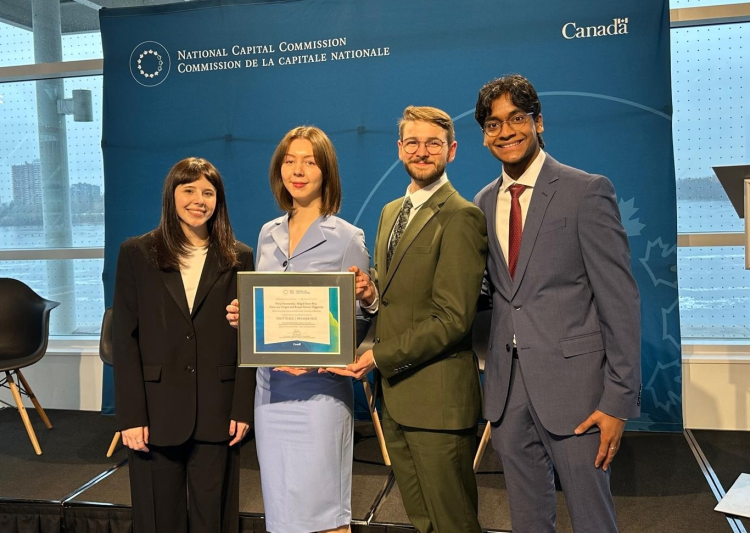
The Concordia alumni team's proposal, "Passage et lieu: Se renouer à Kichi Zibi," centred on three guiding principles: Indigenous leadership and storytelling, ecological resilience and meaningful access to the water.
Abigail Dawe-Roy, BA 24; Niraj Dayanandan, BA 25; Pierre-Luc Gingras, BA 25; and Raquel Stewart Higginson, BA 24, all graduates of the BA in Urban Planning, are now pursuing graduate studies at different universities. They reconnected to compete in the national competition, building on a collaborative foundation first developed during their undergraduate studies at Concordia.
The NCC Design Challenge invites students from across Canada to reimagine key sites in the Ottawa-Gatineau region. This year's focus was Hull Landing, a prominent area along the Gatineau shoreline near the Canadian Museum of History, with direct views of the Ottawa River and Parliament Hill. Participants were asked to develop proposals aligned with the NCC's Capital Core Area Plan, with an emphasis on reconnecting the site to the river while integrating transportation, heritage, accessibility and environmental considerations.
Reconnecting to Kichi Zibi
The Concordia alumni team's proposal, "Passage et lieu: Se renouer à Kichi Zibi," centred on three guiding principles: Indigenous leadership and storytelling, ecological resilience and meaningful access to the water.
Grounded in research on the Algonquin Nation's relationship to Kichi Zibi (the Ottawa River), the project reimagines the site through both physical and cultural restoration. The team incorporated historical portage routes, protected sacred spaces and proposed new gathering areas for Indigenous communities.
They also addressed the transformation of an existing industrial site by proposing its conversion into a civic and cultural hub that could host community events and support regional artisans. A botanical garden featuring plant species representing Canada's diverse ecosystems, alongside plants of cultural significance to Indigenous nations, completes the vision.
"Our proposal builds on the understanding that planning is not just about designing space, but about understanding the histories and relationships embedded within it," Dayanandan says. "Working with community partners during our studies taught us to approach projects in a more thoughtful and grounded way, especially as members external to that community."
A Concordia approach to planning
The former Concordia undergrads cited the Urban Laboratory courses, where students engage in hands-on, community-based planning projects, as foundational to their friendship.
Craig Townsend, chair of the Department of Geography, Urban Planning and Environment, sees the win as a reflection of that pedagogical approach.
"This recognition speaks to the strength of our Urban Planning program and its emphasis on practice-based learning," Townsend says. "Students are encouraged to work collaboratively and engage with communities to propose collective actions that would improve everyday city life and this project reflects those values in action."
Through courses such as Urban Laboratory and Advanced Urban Laboratory, students are asked to balance research, design and stakeholder engagement within tight timelines. For this competition, the team adopted a similar workflow, meeting weekly while managing full-time graduate studies in different cities.
"The experience of working intensively on projects during their undergraduate degree clearly prepared them for this kind of challenge," Townsend adds.
Building momentum
For the Faculty of Arts and Science, the achievement comes at a time of continued development in the field of urban planning.
"This is a meaningful accomplishment for our students and for the department," said Pascale Sicotte, faculty dean. "It highlights the quality of training our students receive and reinforces the role Concordia is playing in shaping the next generation of urban planners."
Beyond the award itself, the project reflects the collaborative spirit that began in the classroom and continued beyond graduation.
"This award is a great honour, especially since we participated in this process as a group of friends from our undergrad," Dayanandan notes.
As the team members continue their graduate studies, their shared experience at Concordia remains a common thread: one that continues to inform how they approach the evolving challenges of planning and design.
Discover Urban Planning and Urban Studies at Concordia.