SFU has signed a strategic research partnership with global shipbuilder Hanwha Ocean to explore collaboration in Arctic technologies, clean maritime energy, advanced manufacturing, and advanced naval systems. The agreement was signed in-person during the BC Innovation Day event hosted by Hanwha Ocean in Victoria, B.C., on Monday, May 25.
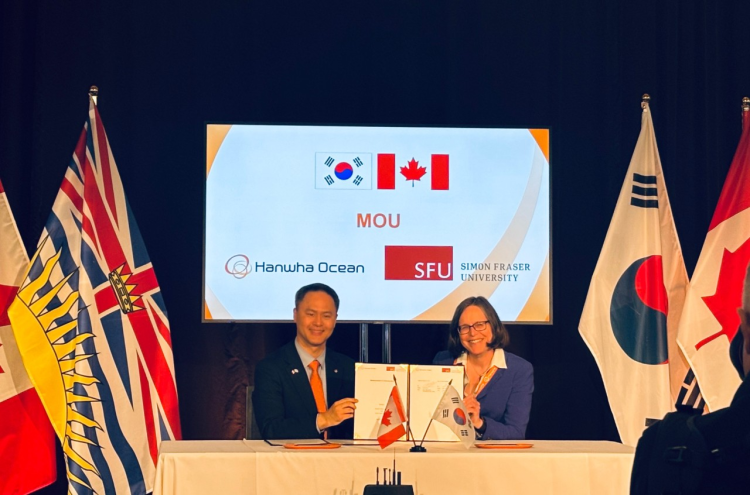
Gunho Kim, Head of Hanwha Ocean's Naval Ship Technologies R&D Center, and Elicia Maine, SFU's associate vice-president, Knowledge Mobilization and Innovation.
The partnership positions SFU at the forefront of emerging opportunities tied to the Canadian Patrol Submarine Project and broader ocean innovation sector, while supporting workforce development and potential industry investment in Canada.
SFU is Canada's leading innovation university and has deep expertise in advanced fields including automated manufacturing, physical artificial intelligence (AI), autonomous robotics and sustainable energy, all of which have significant commercial applications in the shipbuilding industry.
"SFU is pleased to be collaborating with Hanwha Ocean in Arctic and dual-use innovation," says Elicia Maine, SFU's associate vice-president, Knowledge Mobilization and Innovation.
"We see tremendous opportunity to create research advances, emerging economy jobs, and companies with value-added exports here in B.C., while also adding to Canada's Arctic security"
Hanwha Ocean is one of the world's leading shipbuilders, with expertise spanning commercial vessels, naval platforms and offshore energy systems. In recent months, the company has been expanding its presence in Canada through a series of partnerships with universities, industry and government stakeholders as part of its long-term strategy to support Canadian shipbuilding and innovation.
As part of that broader commitment, Hanwha Ocean has announced plans for a Hanwha Arctic & Defence Innovation Centre (HADIC), a proposed Canadian hub that would integrate research, engineering and workforce training to support Arctic operations, autonomous systems and advanced naval technologies. The centre is envisioned as a long-term platform for collaboration with Canadian universities, industry partners and government agencies, with a focus on translating research into real-world applications and building domestic expertise over decades.
"Canada possesses exceptional strengths across shipbuilding, Arctic research, advanced manufacturing, energy, artificial intelligence, and critical minerals," says Hee Cheul (Charles) Kim, President & CEO of Hanwha Ocean. "Through BC Innovation Day, we are proud to deepen our engagement with Canadian partners and explore long-term collaboration that supports innovation, industrial growth, workforce development, and stronger cooperation between Canada and Korea."
As it explores options for HADIC, Hanwha Ocean is hosting the 2026 KOREA-CANADA Joint R&D Workshop in Ottawa on May 26, 2026, featuring leading researchers from top universities and R&D institutes in Canada and Korea. SFU mechatronics systems engineering professor Mehrdad Moallem will participate in the event.
Moallem's research in advanced mechatronics and robotics has potential applications in shipbuilding, particularly his work on robotic welding, and the next step of fully autonomous welding using AI to complete welding tasks without human intervention. SFU has already partnered with industry to explore commercial application of this technology.
SFU is a leader in smart manufacturing and runs the Smart Manufacturing Hub at its Surrey campus, advancing research in digital twins and physical AI while collaborating with local, Canadian, and global manufacturers on future digitalization and AI-driven transformation.
The university also hosts Canada's fastest and most powerful public supercomputer at its Cedar Supercomputing Centre on the Burnaby campus. This national infrastructure supports Canadian companies and public institutions to harness world-class AI infrastructure while safeguarding our sovereignty, security and sustainability. Powered by clean energy and housed entirely in British Columbia, the Centre is a national platform that supports tasks that demand significant computational power, including GPU-intensive model training, simulation and large-scale deployment.
In addition to AI, SFU is a leader in sustainable energy training and research, including through its Sustainable Energy Engineering program at its Surrey campus, and hosting the SFU Clean Hydrogen Hub at its Burnaby campus. The hub leverages SFU's leadership in clean hydrogen research and industry partnerships and demonstrates SFU climate innovation in action. It is a testament to how SFU is engaging in global challenges and focused both on talent development and on economic and social value creation.