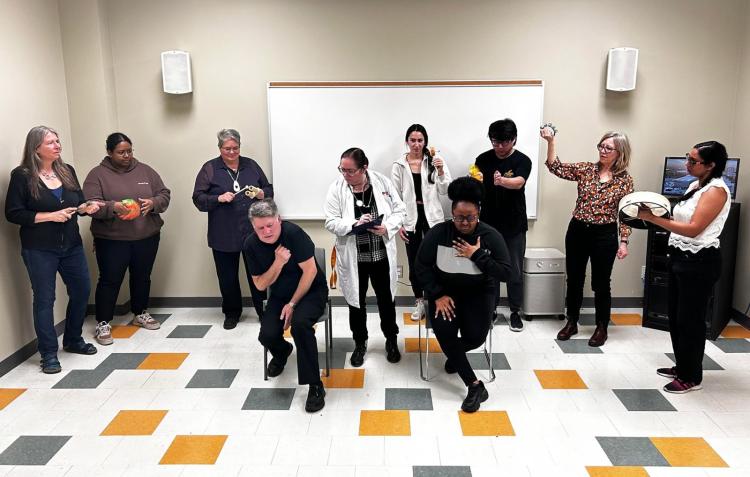
Important lessons can be learned when art imitates life, as Brock University researchers Sheila O'Keefe-McCarthy and Valerie Michaelson have discovered through their work on systemic discrimination in the health-care system.
O'Keefe-McCarthy, Associate Professor of Nursing, and Michaelson, Associate Professor of Health Sciences, are leading an international, multi-disciplinary team using participatory theatre to identify, confront and address health-care discrimination.
Michaelson says dramatizing situations of patients encountering racism, stereotypes, differential treatment and other forms of discrimination is a powerful way to raise awareness and motivate change among students and professional health-care providers.
"It's not as if most health-care providers on their way to work say, Oh, I think I'll go discriminate today,'" she says. "People don't realize they're doing it and don't realize they're caught up in this culture of discrimination. It's often implicit; that's one of the things we're trying to draw attention to."
Intentional or not, O'Keefe-McCarthy says the impacts of discrimination are "incredibly damaging."
"There's a whole list that includes inadequate assessment, inappropriate diagnoses based on implicit bias held by health-care providers," she says. "This translates into sub-optimal pain care, inappropriate treatment decisions and insufficient discharge planning, especially with patients who are racialized, Indigenous, gender non-binary and socio-economically disadvantaged."
To create the scenes for their project, the team interviewed 10 Niagara and Toronto area residents from equity-deserving groups about their experiences of discrimination in the health-care system based on their race, social class, gender and age.
Based on those interviews, the team developed scene scripts for professional performers at Mirror Theatre, a participatory theatre company founded by co-investigator and retired Brock Professor Emeritus of Drama in Education and Applied Theatre Joe Norris.
Over the span of three years, the research team then created and piloted a two-hour workshop for medical, nursing and applied health sciences students and licensed providers. At certain points, the performance stopped so audience members could reflect on different ways to handle the situations depicted.
Michaelson says the participatory theatrical approach is a qualitatively different experience than sitting through an equity, diversity and inclusion (EDI) training session.
She says traditional EDI programs can evoke resistance in some participants who resent "being told what to do" or may give others a "false sense of confidence" that they will never discriminate again because they took the training.
But going through the "back door" of theatre can address those views, Michaelson says.
"When we work through the imagination, we create empathy between the person who is involved in the discrimination and the patient," she says. "Also, when people are actively involved in creating solutions rather than being told from the top down what the solution is, they tend to be much, much more invested."
O'Keefe-McCarthy says the interactive performances also build on the skills being taught.
Theatre is powerful, she says, because it allows participants to pre-live an experience and practice their response using tools provided in the intervention workshop to address implicit bias internally and how it's expressed externally.
Michaelson says preliminary results of pre-and post-workshop analysis were promising, with participants experiencing a "moderate to significantly large" increase in attitudinal change and awareness of cultural competence and humility.
The next step is to explore how to introduce the training into medical school and health-care management and administration, says Michaelson.
The team presented their findings at a May 28 symposium that launched Brock's new Health, Art and Justice Lab.
In addition to Michaelson and O'Keefe-McCarthy, the research team includes Professor Mona Sawhney from Queen's University; Assistant Professor of Education Sherri Vansickle, Associate Professor of Women's and Gender Studies Margot Francis and Professor Emeritus Joe Norris from Brock; Professor Nisha Sajnani and Clinical Professor Joe Salvatore from New York University; and Kevin Hobbs from Mirror Theatre.
Vansickle and Francis led the Indigenous stream of the research, which included additional funding from Brock's Indigenous Research Grant.
Supporting the research is the Government of Canada's New Frontiers in Research Fund.