His background in the classroom might explain why the neuroscientist's newest research focuses on using stem cell models to develop innovative, faster, and safer treatment of dangerous neurological conditions in children.
And that innovative work is getting noticed. Wenzel, an assistant professor at the University of Saskatchewan (USask) College of Medicine, recently received one of the Stem Cell Network (SCN) 25 for 25 Silver Anniversary Awards presented as part of the network's 25th anniversary.
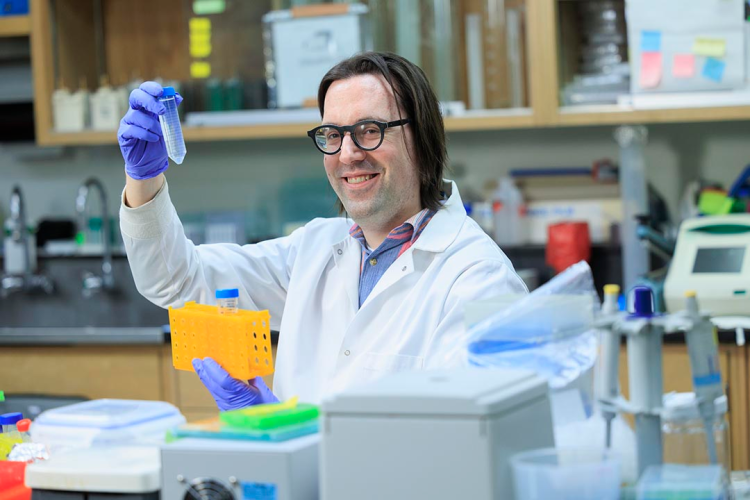
Dr. Tyler Wenzel (PhD), a neuroscientist and assistant professor at USask, works in his lab on campus. (Photo by David Stobbe)
Wenzel was given an SCN Rising Star Award as an early-career researcher who has demonstrated potential for major impact in the field. He is the only researcher in Saskatchewan to be awarded one of the SCN's Silver Anniversary Awards in any category.
"I work in pediatric diseases, and not many people know about or study pediatric diseases. It's great to have an acknowledgement that someone sees this work and it has value," Wenzel said. "One in 12 Canadians have rare diseases, and two-thirds of them are children. This is well over a million children. These diseases are often fatal. Many of these kids will not live to see their 10th birthday because of the lack of research focused on developing or improving treatments for them."
Stem cells are a kind of cell produced in the body that have not developed into specialized types of cells like blood or brain cells. Due to their regenerative properties and unspecialized nature, stem cells have been a core part of modern medical research and innovative treatments.
Wenzel's work with stem cells specifically involves looking at the brain. He has developed tiny "mini-brain" organoids - tiny three-dimensional models made from human tissue - by manipulating stem cells into brain cells.
"How can we study human disease, if we're not using human tissue?" he said. "With these stem cells, we basically have an unlimited supply of human tissue, which means we can have a system where we can focus on the human aspects of disease and treatment."
His current work is in pediatric neurological conditions. Similar to treatments for leukemia and other cancers, the common treatment for many dangerous neurological conditions involves a bone marrow transplant or a stem cell transplant - procedures that first involve chemotherapy or irradiation and have significant mortality rates.
For treating deadly neurological conditions in infants and young children, such as X-linked adrenoleukodystrophy, Wenzel is aiming to establish a procedure where important microglia - brain immune cells - can be delivered directly to the brain without the need for chemotherapy or irradiation.
Wenzel said receiving this recognition from the SCN was extremely validating for the work he is leading at USask.
And as the only Saskatchewan-based researcher on the list, and as a schoolteacher-turned-researcher who is still finding ways to help kids, Wenzel said he hopes up-and-coming stem cell researchers will see that great things can be accomplished in the field here at USask.
"Awards like this recognize the investment that Saskatchewan has put into our work," he said. "I hope it shows people in the same field as me - whether the stem cell or maternal and child health field - that you can move here and get support, and that you will also have a network to help you."
For more information

105 Administration Place
Saskatoon Saskatchewan
Canada S7N 5A2
www.usask.ca