James Ropotar says strong communications skills are essential to the success of engineering projects - particularly when it comes to partnerships with Indigenous communities.
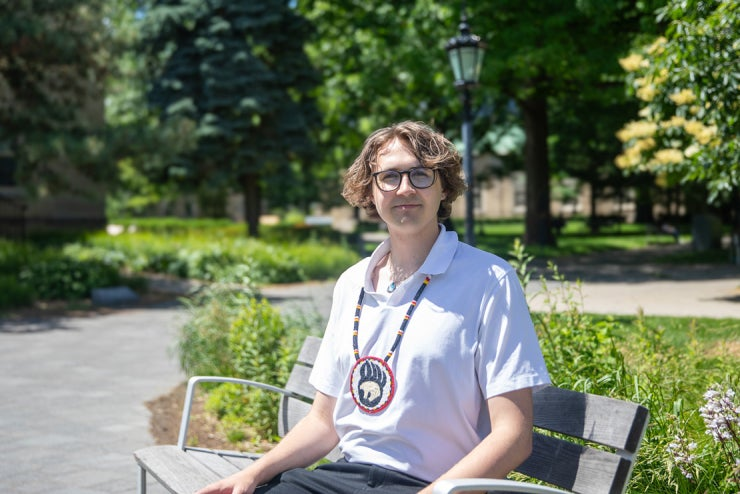
James Ropotar, a master's student in U of T's Faculty of Applied Science & Engineering, is working on a concept of operations for small modular nuclear reactors that integrates Indigenous perspectives into their operating documents (photo by Samantha Younan)
A master's student in the University of Toronto's Faculty of Applied Science & Engineering, Ropotar is currently focused on bridging communications gaps between operators of small modular nuclear reactors (SMRs) and the communities they are meant to support.
Unlike traditional nuclear plants, which are custom-designed and take decades to build and commission, SMRs are smaller and designed around the idea of standardized, repeatable deployment. That makes them a potential solution to the unique energy needs of remote communities - including many Indigenous ones.
But there can be challenges.
"For a long time, I've felt that there's a massive gap in the way we talk about and explain operations, especially when they come to Indigenous communities," says Ropotar, who has Mohawk ancestry and grew up in Kelowna, B.C.
"We can bridge this disconnect with more transparent communication."
In an effort to address the issue, Ropotar is now working in the Cognitive Engineering Laboratory with Greg Jamieson, the lab's director and a professor of mechanical and industrial engineering, and collaborators to integrate Indigenous perspectives in SMRs' operating documents.
Ropotar says he was partly inspired to pursue the project after hearing about the experiences of friends who are members of other Nations and reserves.
"When a project comes on to a Nation, the project proponents might have good intentions and promise a lot of work, but there's a huge language gap and they don't provide the adequate training, which leads to a perceived lack of qualifications," Ropotar says. "We have to say, Hey, the way we describe systems and provide training is vital because we want to use local workers. We want to benefit the community and not have to import workers to operate the local infrastructure.'"
This past year, Ropotar has been researching operations within nuclear plants, which tend to be built and operated through a Western lens, and speaking with Indigenous operators who have experience working in the nuclear sector. Through these conversations, he has sought to identify shortcomings in how reactors and their operating cycles are described and communicated.
"It comes down to a lot of misunderstanding about nuclear and even about what engineering is," says Ropotar. "We're trying to develop new ways of talking about SMRs and work. We need to be inserting the language of a local community or putting concepts into terms that can be understood by a broader variety of people."
With some of the groundwork of his research complete, Ropotar is spending this next phase interviewing communities and conducting a narrative analysis of how they view work and operations within the nuclear sector.
That analysis will inform the development of new training materials and, ultimately, a complete Indigenized concept of operations for future SMR plants - one that rephrases operational concepts within a community's own understanding of systems and values.
"Technical documentation carries embedded assumptions about hierarchy, relationships and whose values a system is built to serve," Ropotar explains. "For example, we sometimes describe automation as a master/slave system. That kind of terminology doesn't match the communities a system is meant to benefit."
Ropotar, who completed his undergraduate studies in manufacturing engineering at the University of British Columbia, is incorporating the Seventh Generation Principle into his work, honouring the Indigenous philosophy that the decisions we make today should result in a sustainable world seven generations into the future.
"We want to think about creating a better world and continuing the cyclical idea of making improvements, not purely extracting but creating something better for future generations," he says.
"I think successful communication looks like a clean, constructive two-way dialogue between any Nation that wants to develop this power infrastructure and the agency trying to bring the power infrastructure online. That dialogue considers both the community values and needs, as well as things like operations and worker training."
One of the ways Ropotar has made contacts with Indigenous people in the nuclear sector is through his work with the Advancing Indigenous Science and Engineering Society (AISES), where he currently serves as president of the U of T chapter.
Beyond his own research and work with AISES, Ropotar says building Indigenous representation means recognizing the continuing presence and perspectives of Indigenous communities.
"Thinking about the rich Indigenous history we have in Canada also means reflecting on and remembering that it's not just history. It's ongoing. We're still here," he says. "We need to be continuously talking about First Nations, about culture, about the way that the communities have grown, the history that shapes them and about the land that we're on, and how we're really taking care of it."