

Two years ago, a University of Calgary research team set out to answer a simple but ambitious question: could a sensor reliably measure nutrients in agricultural liquids without ever touching them?
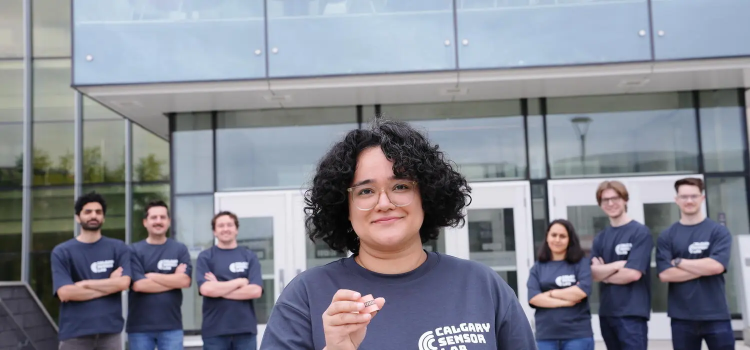
Dr. Zahra Abbasi with her Calgary Sensor Lab team. Photo Courtesy: Husaina Husain, Communications
Today, that idea is rapidly becoming reality, with meaningful implications for how farms manage nutrients.
Nutrient monitoring is often slow, expensive or incomplete, meaning many producers rely on estimates when applying manure or fertilizer. That uncertainty can lead to overapplication, added costs, and environmental harm.
At the Schulich School of Engineering, Dr. Zahra Abbasi and her team at the Calgary Sensor Lab have made significant progress in developing a microwave-based nutrient sensor designed to provide real-time data on nitrogen, phosphorus and potassium, the three nutrients farmers most need to measure and manage.
Moving from proof of concept to precision agriculture
"When we started, we were asking if we could detect one nutrient," says Abbasi. "Now, we can measure them in combination."
That leap marks a critical shift in the research. The team has successfully validated all two-nutrient combinations, moving closer to their next milestone: detecting all three simultaneously in a single measurement.
Just as important is how they have achieved it.
Rather than relying solely on data-driven models, the researchers built a physics-based system that explains how and why the sensor works. The result is a more transparent and reliable approach one that builds trust as the technology moves closer to real-world use.
The innovation is also gaining traction beyond the lab. Developed in partnership with Livestock Water Recycling (LWR), a Calgary-based industry partner, the technology reached a key milestone in December 2025 when the team filed a U.S. patent an important step toward commercialization and broader adoption.
Turning data into decisions on the farm
For farmers, the impact could be immediate and practical. Rather than a handheld device, the sensor is designed to sit inside the manure treatment system itself, taking continuous readings as the liquid flows through no sampling, no lab, no waiting. That data flows straight into the systems farmers already use, so knowing what's in the manure becomes as routine as checking a gauge. It is a part of a broader shift in agriculture where manure is becoming a measurable, manageable asset rather than a byproduct to dispose of.
Abbasi's sensor changes that equation.
"Instead of fertilizing based on assumptions, farmers could make decisions based on what's happening in real time," she says.
With continuous data, producers can adjust how much they apply and when, matching nutrients to crop needs more precisely. That means fewer inputs, fewer passes over fields and less risk of excess nutrients running into nearby waterways.
Building toward real-world deployment
The research team is now working toward a fully integrated prototype that can operate in real agricultural environments.
That includes an unexpected bonus. Manure is really a mix of two things: nutrients dissolved invisibly in the liquid, like salt in water, and small solid bits floating in it that make it look thick and cloudy. The sensor can now track both at once and tell them apart, which makes it far more useful in something as messy as real manure.
From there, the next steps include system integration, validation, and field testing on farms, with trials expected to extend through 2027.
Working closely with LWR, the team can test the sensor using real-world samples and design it to fit into existing manure management systems.
"A lab can build a great sensor," says Abbasi, "but it has to work in the reality of how farms operate."
A team effort with lasting impact
At the heart of this progress is a highly engaged team of students and researchers.
From developing new sensor designs to refining models and testing performance, Abbasi credits her team's curiosity and persistence for many of the project's key breakthroughs.
"The sensor is important," she says, "but the people behind it are the real output of this lab."
Together, they are building more than a device; they are helping shape a future where Canadian farmers have access to affordable, real-time data to guide their decisions.
For Abbasi, that's where the impact becomes personal.
"If we can help farmers use nutrients more efficiently, protect the environment and produce more food with fewer resources," she says, "that's something that truly matters."
For more information on Abbasi's research, visit the Calgary Sensor Lab website.