Throughout his life, Chancellor Emeritus Lynton "Red" Wilson '62 believed Canada needed leaders who could look beyond the challenges of today and think strategically about the opportunities of tomorrow.
A new gift from Wilson to McMaster University will help students develop that ability.
McMaster is creating the Futures Institute at Wilson College through an $8-million gift from the late Red Wilson and the Wilson Foundation. The institute will help students recognize early signals of change, explore plausible futures and develop the skills needed to make thoughtful decisions in an increasingly complex world. Drawing on evidence-based research, students will learn how political, social, economic, environmental and technological changes shape the choices facing communities, organizations and governments.
At its heart is a new undergraduate certificate in futures thinking and social innovation, along with an annual symposium that will bring together students, leaders and researchers to examine emerging issues and help map Canada's path forward.
This investment builds on Wilson's transformative support of McMaster, including his landmark $50-million contribution in 2022 that established the Wilson College of Leadership and Civic Engagement.
The college welcomed its first cohort of 50 students in September 2025 and reflects Wilson's lifelong commitment to preparing engaged, forward-thinking leaders.
"Red Wilson understood that leadership begins with the ability to see beyond the immediate moment," said McMaster President Susan Tighe. "For more than 60 years, he supported McMaster with remarkable generosity and vision."
"This gift ensures future generations of students will have the opportunity to develop the perspective and skills needed to help Canada navigate uncertainty."
Teaching the skills to see beyond tomorrow
The Futures Institute will give students practical tools to understand long-term forces, spot early signals of change and think through a range of possible futures. Students will learn strategic foresight methods that are critical for planning in private, public and civic sectors.
Accelerating climate change and Canada's housing crisis are just two examples of why this kind of thinking matters. While many policies focus on immediate pressures, a future-focused approach considers demographic shifts, climate migration and changing work patterns to anticipate how needs may evolve over time.
"The Futures Institute will encourage students to think further ahead as they navigate diverse issues," said Jeremiah Hurley, dean of Social Sciences and co-lead of Wilson College. "Its emphasis is on what may be emerging, not just what is unfolding today, prompting students to explore longer-term questions such as the future of health-care policy in Canada or how our relationship with the U.S. could shift in the next 10 years."
The institute builds on Imagining 2080, a McMaster-led event in 2023, where participants pictured Canada nearly six decades into the future. They explored regional prosperity, reconciliation with Indigenous Peoples and clean-technology leadership, then asked what choices today could make that future possible.
"Imagining 2080 showed us what happens when diverse voices are asked to think systematically about tomorrow," said Sean Corner, acting dean of Humanities. "The Futures Institute will make this kind of long-range thinking central to our students' education."
Building capacity across campus
The planned futures thinking and social innovation certificate will be open to students across faculties. Its coursework draws from influential thinkers and practical tools in the field, helping students see how key decisions in the past changed the country's trajectory and how similar turning points lie ahead.
What is futures thinking' and why does it matter?
The Futures Institute will expand Wilson College's existing residency program through an executive-in-residence, who will bring futures thinking practitioners and leaders directly into campus life. Through talks, workshops and mentorship, they will help students understand how scenario planning and foresight methods guide governments, businesses and organizations through disruptive change.
The gift will support the leadership and programming needed to embed futures thinking across McMaster.
Sanjay Khanna, a strategic foresight advisor, consultant and previous lecturer in McMaster's Public Policy Program, will serve as the Institute's inaugural director. His work spans strategy, public policy, climate change, planetary health, technology, design and social resilience, helping governments, businesses, universities and non-governmental organizations use foresight methods to navigate uncertainty and plan for long-term change. His experience will help connect the institute's work with expertise across McMaster's faculties and research communities.
"The challenges that will shape Canada's future do not fit neatly within a single discipline," said Khanna. "The Futures Institute will bring together students, researchers and community leaders to explore emerging issues, test assumptions and think carefully about how decisions made today may shape the decades ahead."
The gift will also support certificate development, the annual symposium and expertise to design courses, connect students with practitioners and build partnerships.
Lara Campbell, academic director of Wilson College and history professor, says the institute is a natural next step.
"Wilson College was founded on the principle that Canada needs thoughtful and prepared leaders," said Campbell. "The Futures Institute will teach students not just to understand the present but to think ahead with care and discipline."
The initiative will connect students and researchers across campus, drawing on expertise from the Susan Cunningham Science Leadership Academy, the Foresight Lab in the DeGroote School of Business, the Communications Governance Observatory in Humanities, the Digital Society Lab in Social Sciences and McMaster's business incubator, the Forge.
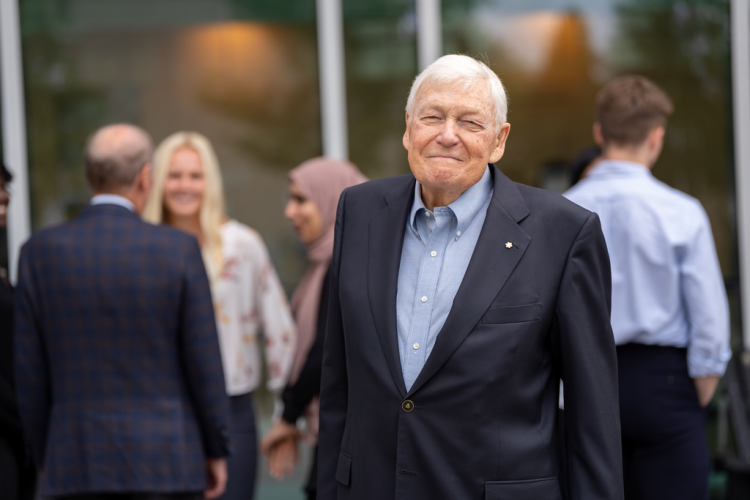
In September 2022, Wilson announced a gift of $50 million to establish the Wilson College of Leadership and Civic Engagement.
Red Wilson's lasting impact
Wilson's giving to McMaster spanned more than six decades. As one of the university's most influential alumni, volunteers and philanthropists, he created opportunities for generations of students through his service and generosity.
His contributions strengthened the liberal arts, leadership development and student success across the University. L.R. Wilson Hall carries his name, and his philanthropy helped power the Future of Canada Project, the Wilson Leaders program, the Wilson Institute for Canadian History, several bursaries and many initiatives shaped by civic purpose.
Wilson College, a partnership between McMaster's Faculties of Humanities and Social Sciences, is home to Canada's only Combined Honours Bachelor of Arts degree in Leadership and Civic Studies. The college focuses on ethics, responsibility and service, helping students develop the historical context and societal awareness that are hallmarks of great civic and community leadership.
Wilson served as McMaster's chancellor from 2007 to 2013 and was a longtime champion of the university's mission. He was an Officer of the Order of Canada, a recipient of the Vanier Medal for public service and a respected leader in Canadian business, government and public life.
What is 'futures thinking' and why does it matter?
Practitioners pay close attention to signals of change, from shifts in climate, housing and population health to new technologies and changing societal trends. They follow these developments to better understand the opportunities and challenges they may create for communities, institutions and public policy
In Canada, futures thinking is used across government, research and industry, including by Policy Horizons Canada, which describes it as a practical way to understand how change unfolds and how thoughtful action can guide it.
This approach fits naturally at McMaster, where students are encouraged to connect ideas across disciplines and to consider how society responds to complex challenges. Wilson College builds on that foundation by asking students to think about responsibility, public purpose and how decisions shape community life.
The Futures Institute strengthens that work by giving students tools to think further ahead, weigh evidence, challenge assumptions and better understand how present choices affect the world they will inherit. It also recognizes that good ideas only matter when they can be communicated, debated and translated into informed action.