In the lab, Manoj Jangra studies how to fight bacteria that no longer respond to existing antibiotics, an evolutionary phenomenon called antimicrobial resistance.
In McMaster University's Masterclass: Foundations of Commercialization, he learned to explain why that research could matter beyond the lab and what it might take to move it forward.
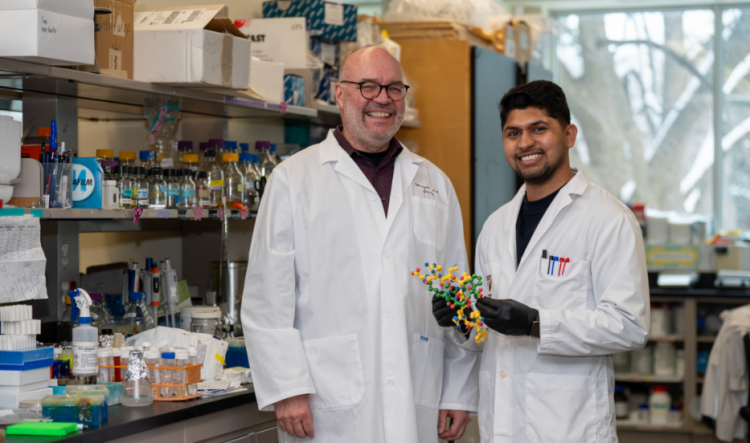
Researcher Gerry Wright, left, and postdoctoral fellow Manoj Jangra, holding a 3D-printed model of lariocidin, the new antibiotic that they discovered together. (Photo by Georgia Kirkos, McMaster University)
"I entered the program as a scientist, and came out as a commercial entrepreneur," says Jangra, a postdoctoral fellow in McMaster's Department of Biochemistry and Biomedical Sciences.
That mindset shift helped earn him the $50,000 top prize in the Heersink ACE50 Pitch Competition, which challenges McMaster innovators to make the case for the commercial potential of their ideas.
Moving promising science to market
Jangra joined the lab of McMaster researcher Gerry Wright in 2021, bringing a background in applied microbiology and antibiotic discovery.
He spearheaded the discovery of lariocidins, a promising new class of antibiotics discovered in soil samples collected from a Hamilton backyard. Jangra led the research with contributions from other members of Wright's team, and the findings were described in a landmark paper published last year in Nature.
Rather than attacking bacteria through mechanisms used by current antibiotics, lariocidins target a previously unexploited site within the machinery bacteria use to produce the proteins that are essential for their survival.
While the research remains preclinical and further testing and development are needed, a new treatment with these characteristics could offer an important alternative for critically ill patients with infections that no longer respond to conventional drugs.
For Jangra and his colleagues, who are based at the Michael G. DeGroote Institute for Infectious Disease Research, the scientific promise is clear enough to pursue. The challenge now is understanding how the discovery might become a viable treatment and product.
Masterclass helped him to define the problem more precisely, connect a solution to that need, and explain its market potential. The six-session program covered topics including market sizing, business models and intellectual property. A live pitch practice gave participants a chance to receive feedback and learn from one another's presentations.
"One thing I learned is that antimicrobial resistance isn't the problem," Jangra says. "It's a category."
Antibiotic resistance is a global challenge, but a business pitch needs to be more precise. What specific problem could the technology address, he explains, and then what would it take to bring it to market?
Learning to make the case
The Heersink ACE50 competition gave him a chance to put those lessons to work. When he learned he had won, he says, he was thrilled and surprised due to the strength of the other pitches. The award also offered reassurance about the promise of his discovery.
"It was validation of our technology, that people outside our field could see the commercial potential," he says. "And validation of our team, which has been working over all these years to make this happen."
Jangra says the prize will help establish a planned Hamilton-based spinout, Hammer Therapeutics. He expects to use some of the funding for the company's formation, branding and advisory board, and the rest to train a postdoctoral fellow or PhD student. That trainee could eventually become the company's first employee.
The plan is to advance lariocidins through further research and reduce some of the risks associated with their development. A spinout could also make the work eligible for funding available to startups, and help the team build toward a future partnership with a pharmaceutical company.
Jangra will also enter McMaster's Heersink ACE50 Fellowship, a six-month program offering coaching and mentorship to help winners develop their commercialization plans. He also hopes to continue building his knowledge of entrepreneurship and leadership as the research moves into its next phase.
He hopes other scientists will make room for this kind of learning, too. He had pitched his research before taking Masterclass, but the program helped him see that a strong scientific idea also needs a clear explanation of the problem it addresses, its market potential and a path forward.
"I would recommend everyone who wants their discovery to go beyond the lab to take a course like this at McMaster and learn more about commercialization," he says.
Other ACE50 Award recipients
The Heersink ACE50 Pitch Competition faculty awards included $25,000 prizes for Lauren Fink (Faculty of Science), Rogelio Cruz Gonzalez (DeGroote School of Business), and Dongdong Wang (Faculty of Health Sciences). The $25,000 Faculty of Engineering award was shared by Fereshteh Bayat and Andres Escobar. Professor James MacKillop received the $10,000 Pitch Prize Favourite award.
The winners were announced at McMaster's Entrepreneurship Week's Innovation Showcase on Nov. 16.