Throughout Canadian Library Month, libraries and library partners across Canada are celebrating the important role that libraries play in our lives. Beyond providing access to books, libraries foster cultural awareness, strengthen communities, offer educational programs, support freedom of expression, and provide valuable resources for people of all ages.
The Dr. John Archer Library and Archives at the University of Regina is here to help students thrive during their time on campus. They offer a variety of events, programs, and workshops for students, including the AI Literacy Badge and the Digital Research Skills Certificate. Both of which were developed to give students the digital literacy skills that they need to be successful academically and professionally.
Graduate students need to be able to navigate an increasingly complex landscape of digital tools. Not only do they need to be comfortable with these tools to advance their studies, but familiarity with them is also useful for their post-graduation working lives. Cara Bradley, Research & Scholarship Librarian at the Archer Library
The AI Literacy Badge
The AI Literacy Badge is a digital badge that recognizes participation in AI literacy workshops provided by the Archer Library. The Badge is free for all students, and the workshops teach the basics of how Generative AI works and how to use AI tools responsibly to support your studies and learning.
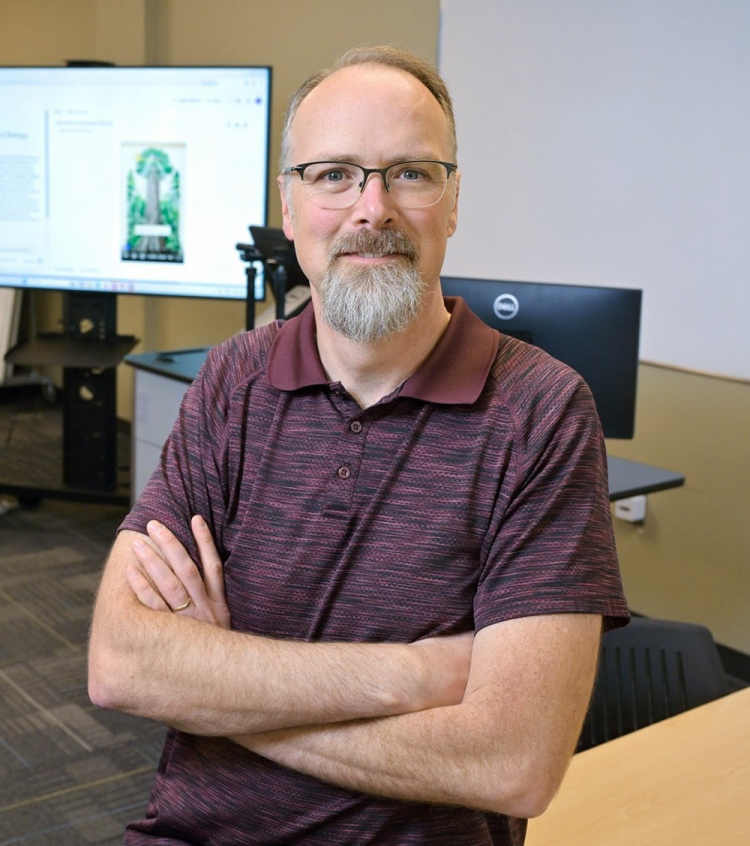
Brad Doerksen oversees the Archer Library's AI Literacy Badge. Photo credit: University Communications and Marketing
To earn the Badge, students must attend five workshops -- one in the AI Fundamentals category, three in the AI in Education and Research category, and one in the AI in Society and the Workplace category. A full list of upcoming workshops is available on the Archer Library website.
"Rather than having a fixed curriculum of five workshops, we tried to design it so that students can go to whichever workshops are of interest to them," says Brad Doerksen, Student Success Librarian. "We are not trying to promote nor discourage AI use, but we do want to ensure that students can responsibly and critically engage with it."
Doerksen hopes that students can think about the big picture, and how they want AI to fit into their studies, their lives, and their careers.
"Easy isn't always better," says Doerksen. "The habits that you form in year one can shape your entire academic career," says Doerksen.
Once students have completed all five required workshops, a digital badge is issued to them in MyCreds. The Archer Library is also working to set up Badge progress tracking in UR Path. Stay tuned!
Digital Research Skills Certificate
The non-credit Digital Research Skills Certificate is available to all graduate and postdoctoral students who are interested in developing their digital research skills and engaging in the graduate professional development community at the U of R. It was developed in 2022 by Cara Bradley, Research & Scholarship Librarian at the Archer Library and Dr. Aziz Douai, former Dean of the Faculty of Graduate Studies and Research after more and more students began asking for letters confirming they had taken one-off digital research workshops through the Archer Library.
Bradley and Douai decided to create a non-credit certificate that was free to students that utilized many of the Archer Library's existing workshops."We took some of the existing workshops that we were already offering, and it also prompted us to create some new workshops," says Bradley. "The workshops are continually evolving because these tools and the digital landscape is continually changing."
Once students complete the certificate, they can add it on their resume to demonstrate that they have the ability to apply advance search strategies in their information searches, assess the applicability of, and use, select software programs to carry out their research, and conduct research and manage research data in an ethical and legal manner.
"Graduate students need to be able to navigate an increasingly complex landscape of digital tools," says Bradley. "Not only do they need to be comfortable with these tools to advance their studies, but familiarity with them is also useful for their post-graduation working lives."
To complete the certificate, students must complete four required workshops and three elective workshops on topics including research data management, various research-related software programs, literature reviews, digital copyright concerns, among others. A list of the full program requirements, as well as a schedule of the upcoming online workshops, are available on the Archer Library's website.
The Archer Library tracks student attendance at each of the workshops, and once a student has met the requirements of the certificate, the Faculty of Graduate Studies and Research will issue their Certificate.
The 2026 theme for Canadian Library Month is Loud for Libraries / Haut et fort pour les bibliothèques, designed to challenge the perception of libraries as passive spaces and to highlight their role as hubs for dialogue, creativity, and civic participation. It is also part of a broader effort to raise awareness about the essential role libraries play in the lives of Canadians. Visit the Dr. John Archer Library and Archives, as well as your local library, to show your support!