Three University of Guelph researchers are joining scientists from across Canada in Ottawa this week for Science Meets Parliament, an initiative that connects researchers with federal decision-makers to explore how scientific evidence can inform public policy.
Dr. Diana Lewis, professor in the Department of Geography, Environment and Geomatics, College of Social and Applied Human Sciences (CSAHS), Dr. Daniel Onwude, professor in the Department of Food Science, Ontario Agricultural College (OAC) and Dr. Jennifer Geddes-McAlister, professor in the Department of Molecular and Cellular Biology, College of Biological Science (CBS) will participate in the 2026 program presented by the Canadian Science Policy Centre (CSPC) and the Office of the Chief Science Advisor.
Through workshops and meetings with parliamentarians and public servants, delegates learn how policy decisions are made and how research can inform them. Parliamentarians, in turn, gain insight into current research and the expertise available at Canadian universities.
"The greatest impact of scientific discovery comes when research informs the policies, partnerships and decisions that shape Canada's future," says Dr. Mazyar Fallah, vice-president, research and innovation. "Drs. Lewis, Onwude and Geddes-McAlister bring critical expertise to some of the country's most pressing challenges, demonstrating the value of connecting university research with public policy."
Research with real-world applications
Dr. Diana Lewis

Lewis, a member of Sipekne'katik First Nation and Tier 2 Canada Research Chair in Indigenous Environmental Health Governance, works with Indigenous communities to co-develop Indigenous-led frameworks for assessing the environmental health risks of resource development.
As resource development projects move forward, Lewis is working with Indigenous communities to develop risk assessment frameworks that reflect Indigenous perspectives and consider the potential health, environmental and cultural impacts of industrial operations. The goal of our research is to help communities lead decisions about projects affecting their lands while trying to influence future policy and regulations.
"Scientific evidence, including Indigenous scientific evidence, is putting research into action, potentially influencing how decisions are made," says Lewis. "Indigenous Peoples in this country have Aboriginal and treaty rights that must be accommodated, and in response to the fast-tracking, repeatedly express concerns about how industrial development puts the health of their communities at risk.
"In my research, I work alongside Indigenous community members to co-develop frameworks and establish baseline health data that can help inform decisions before projects of national interest move forward."
Dr. Daniel Onwude
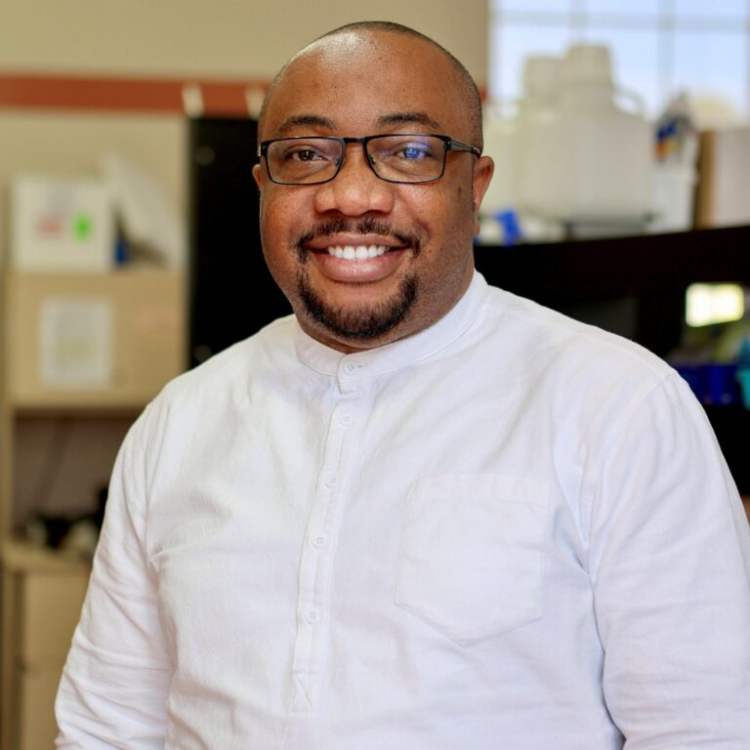
Onwude, a Tier 2 Canada Research Chair in Computational Food Systems and Precision Nutrition, uses artificial intelligence and computational modelling to address food loss, improve food security and support more sustainable, resilient food systems and healthier communities.
As food security and sustainability are increasingly shaped by global challenges, Onwude sees an important role for scientific research in helping policymakers anticipate disruptions, address food loss and protect the nutritional quality of Canada's food supply.
"Global trade uncertainties and extreme weather events are putting pressure on Canada's food supply. Meanwhile, 46.5 per cent of Canada's food supply is lost or wasted annually, representing an estimated $58 billion in food," says Onwude. "My research combines real-world data, artificial intelligence and computer-based simulations to anticipate food supply chain disruptions, evaluate interventions, reduce food loss, preserve food quality and nutrition, and strengthen food system resilience.
"Science Meets Parliament provides an opportunity to connect these insights with policy decisions and build partnerships that translate research into practical solutions for Canadian farmers, food processors and consumers."
Dr. Jennifer Geddes-McAlister

Geddes-McAlister, a Tier 2 Canada Research Chair in the Proteomics of Fungal Disease in One Health, uses advanced proteomics (the study of proteins) to investigate how fungal pathogens cause disease, evade immune responses and develop resistance to treatment. Her research aims to advance diagnostics and therapies, address antifungal resistance and protect human health and food systems.
Fungal diseases threaten human health, agricultural productivity, food safety and global food security. Geddes-McAlister's research aims to translate advances in proteomics into better disease monitoring and more resilient food systems.
"Fungal diseases threaten agricultural productivity by damaging crops, reducing yields and contaminating food with harmful toxins," says Geddes-McAlister. "My research helps uncover how fungal pathogens cause disease to improve detection and management strategies, protect crop health, reduce food production losses and strengthen Canada's food security.
"Building relationships with policymakers and involving them from the beginning of the research process, through discovery and planning for implementation, can help bridge the gap between scientific discovery and real-world applications."
Supporting Canada's science-policy community
U of G has partnered with the CSPC's annual Canadian Science and Innovation Policy Conference, taking place in Ottawa Nov. 24- 27 immediately following Science Meets Parliament. The conference brings together leaders from government, academia, industry and society to discuss issues shaping Canada's science, technology and innovation landscape.
As part of the conference, the Arrell Food Institute at the U of G will host a panel, "Strengthening Canada's Food Sovereignty Through Policy, Science and Research," on Nov. 26 from 11 a.m. to 12:15 p.m. The session will explore how science, research and coordinated policy action can strengthen Canada's food sovereignty and address vulnerabilities in the national food system.