Conspiracy theories aren't new. For centuries, they've been used to target groups cast as outsiders, from anti-Semitic myths in Europe to misogynistic and xenophobic narratives that frame social change as a threat. These stories have been used to divide societies and consolidate power.
Today, those same dynamics are playing out in a digital world where misinformation spreads faster, reaches wider audiences and shapes public discourse in ways that undermine trust and threaten democratic institutions.
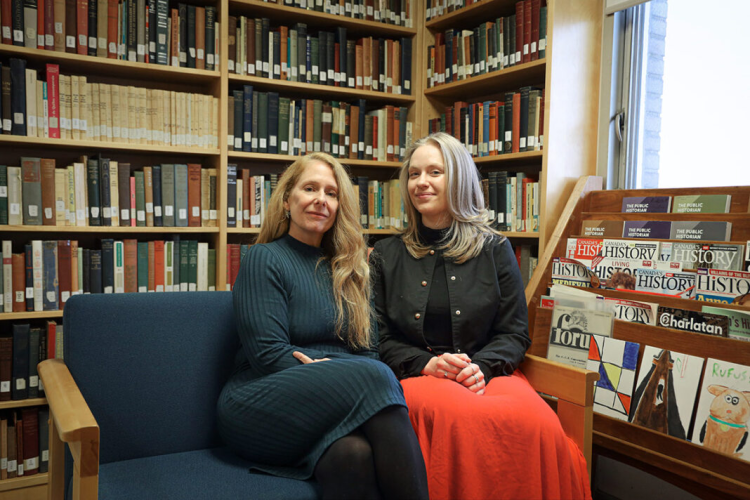
Carleton University history professor Jennifer Evans and Carleton University master's student Fionnuala Braun (photo by Brenna Mackay)
Carleton University history professor Jennifer Evans is studying how conspiracy theories evolve and why they resonate. Leading the Populist Publics project with Carleton communications professor Sandra Robinson, Evans is tracing conspiracy narratives across history to understand when they emerge, who they target and how they adapt to new media.
Her goal is to help people develop the critical skills needed to recognize and resist conspiratorial thinking.
A Historian's View on Modern Conspiracy
We can't understand conspiracy theories without looking at how information circulates online, according to Evans.
"The biggest change is social media," she says.
"Our belief that we understand how it works because we're users is harmful. The mechanisms aren't transparent and it takes sophisticated tools to interpret what we see."
People feel like they have a window into what others think online, but they're seeing a curated perspective shaped by algorithms, influencers and bad actors.
Evans' research shows that conspiracy theories tend to surface at moments of upheaval economic instability, pandemics, political disruption when people are trying to make sense of rapid change.
"Conspiracy theories are best understood as having both irrational and rational elements," she explains.
"People are trying to find answers and language to interpret massive changes around them and they land on alternative explanations that make sense to them."
Those explanations fill gaps left by institutions struggling to communicate clearly or quickly. During COVID-19, for example, shifting guidance, confusing messaging and gaps in public communication created fertile ground for misinformation.
Fionnuala Braun a Carleton master's student working with Evans who studies trust and misinformation in the public health sphere says conspiracies often begin with uncertainty, not ideology.
"People are drawn to conspiracy theories when official sources are confusing," says Braun.
"When they feel they're not being told the full story, they'll turn to unofficial and unreliable sources."
A digital ecosystem that rewards outrage lets fringe ideas move quickly into mainstream spaces. Conspiracy narratives targeting racial, religious, queer and trans communities can be amplified by politicians and media figures, then repeated as everyday talking points.
For Evans, that shift is a warning sign. She views the targeting of minorities as a bellwether for the health and safety of a democracy, and says we need to pay close attention when radical ideas become normalized in everyday speech.
Countering Conspiracies Through Literacy and Empathy
If conspiracy theories thrive on confusion and mistrust, countering them requires more than debunking false claims. Evans is focused on practical ways for classrooms, communities and public institutions to respond.
A key strategy is translating research into tools people can use.
"We're writing policy briefs and best practices for diverse groups governments, social workers, teachers, professional organizations," says Evans.
"We're also developing teaching modules, because teachers are the frontline. They can help students approach and navigate complex issues."
Digital literacy is another cornerstone. Evans notes that AI-generated content has made manipulation difficult to spot, especially for the average person.
"It's much harder for us to see manipulation," she says. "We have a really hard time distinguishing between truth and fiction, and that's a massive challenge."
How we react to misinformation matters as much as what we say, says Braun, who cautions against approaches that centre on argument and correction alone.
"Debunking doesn't work," she says.
"Nobody wants to be talked at. The best thing you can do is be empathetic let people know you're listening."
Instead of cutting people off, Braun emphasizes keeping lines of communication open, acknowledging confusion and shared frustrations and building trust over time. Undoing misinformation is a slow process but essential to prevent people from drifting further towards harmful, conspiratorial communities.
Evans' team is also exploring short-form digital storytelling and creative collaboration to foster empathy and reflection, bringing together students and people affected by hate to share experiences and think about how conspiracy-driven narratives shape their lives.
There's no quick fix to countering conspiracy theories. By combining historical insight, digital literacy, policy guidance and empathy, a future where fewer people are vulnerable to narratives that weaponize fear and where democratic societies are more resilient against them is within reach.