Literary analysis has taken on new meaning for students in Dr. Roger Davis's English 220 course. Davis, who is Head of English and has been an instructor at Red Deer Polytechnic since 2011, has found an engaging way to teach his students about literature, culture, ethics, politics and society: he has creatively gamified the course, turning it into a zombie apocalypse for them to navigate.
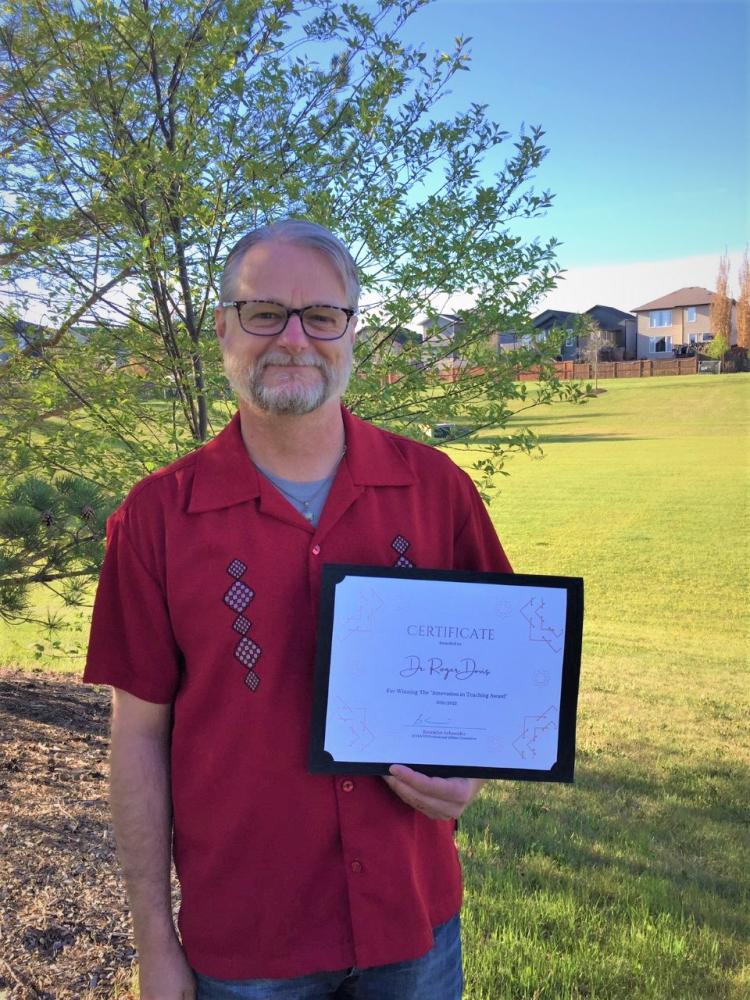
Dr. Roger Davis
His efforts have been recognized at the provincial level and, earlier this month, Davis received the Alberta Colleges and Institutes Faculties Association (ACIFA) Innovation in Teaching Award. This prestigious provincial teaching honour is presented to one instructor in Alberta each year, making this a significant accomplishment for Davis.
"The unique approach Dr. Davis has thoughtfully integrated into his English 220 course demonstrates interdisciplinary, applied learning that can resonate with students in powerful and memorable ways," says Kylie Thomas, Vice President Academic and Provost. "Roger has incorporated a cultural scenario that allows students to investigate science, politics and communications in ways that are not commonly found in more traditional literary studies. It is an exciting approach that provides an innovative way for students to engage with literature and culture."
For Davis, the idea of creating an apocalyptic zombie world in English 220 evolved from his own research interests in monstrosity and zombies, along with the thematic prevalence of zombies in popular culture. Then, at an international teaching seminar in Portland, Oregon, he was inspired about the possibility of gamifying the course. This would allow students to immerse themselves in a simulated environment, transforming conventional learning activities through a game-style approach to increase engagement and motivation.
"Studying literature can involve many aspects beyond the capital L' literature of traditional texts," he says. "Reading and watching films is also a consumption of cultural products, beyond mere entertainment, and it can help us to understand the society in which we live in a deeper and more meaningful way."
In his English 220 class, Davis provides the framework for this understanding by immersing students in the gamified world. The narrative for this game is centred around a key premise: the students wake up in class with a zombie apocalypse underway, and they have to survive. Each student has to develop a character for themselves, with parameters for their gender, age, occupation and beliefs determined by a random game of chance. Then, they have to establish their geographical location and political structure before embarking on their major project - a group project where they have to establish infrastructure that will contribute significantly to society.
"The point, in many ways, is to get students to inhabit someone other than themselves to give them a better understanding of difference and diversity," Davis explains. "This becomes a larger social experiment, where students have the opportunity to determine what kind of community they want to imagine and build."
As students are working together and creating this world, Davis connects the learning back to a variety of texts. The expansive graphic novel series, The Walking Dead, provides an easy cultural touchstone. Other texts, including short stories that may touch on everything from zombies to trauma, can inform and expand student understanding because, as Davis notes, zombies create a flexible metaphor for learning.
"Zombies, in particular, are unique across literature and culture because of the unusual level of violence enacted upon them," he says. "As a metaphor, this violence is often about eliminating the otherness' that we don't like in society, and so we explore this negative perspective as a class. But, on the positive side, the gamified zombie world that students experience is also about reinventing ourselves, so students gain a deeper understanding about the complexity of society."
After teaching six sections of this course across two academic years, Davis still finds that he is learning with and from his students. "This type of teaching and learning involves a lot of open-endedness and flexibility from everyone involved," he says. "It requires a great deal of creativity and high-level thinking skills from students, but I look at it as problem solving. They have the opportunity to consider ethics, politics and society as they create a community and research projects that are applied and practical. These outcomes will continue to serve them well, no matter what field of study they pursue."
Read more about Davis's many accomplishments and interests by visiting his instructor biography.
Additional information about the ACIFA Awards is available on their website.