The Canadian Severe Storms Laboratory (CSSL) is celebrating a strong first year of research, collaboration and public impact.
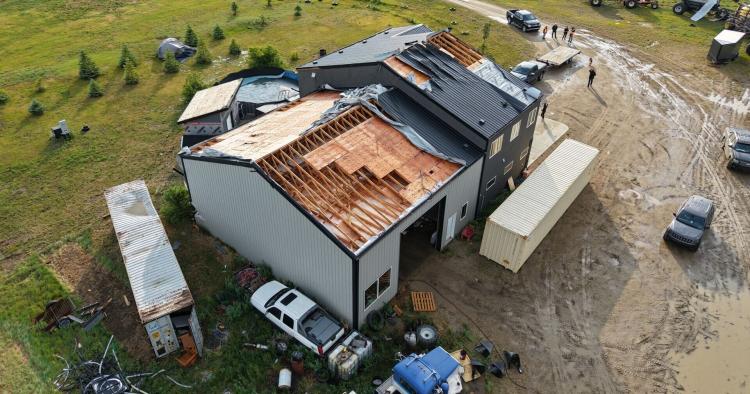
A house with attached workshop that sustained roof sheathing damage in the Kroneau, SK EF2 tornado on June 19, 2025. (Dylan Painchaud-Niemi)
Formed in October 2024 at Western with generous support from ImpactWX, CSSL brings together scientists and engineers to better understand severe storms and improve Canada's resilience to extreme weather.
"Over the past year we've built a strong foundation for the Canadian Severe Storms Laboratory and expanded the reach of our research across the country," said Gregory Kopp, director of CSSL and ImpactWX Chair in Severe Storms Engineering at Western. "We're proud of the progress our team made in 2025 and excited about the impact this work is already having."
Marking its first year of innovation and excellence, CSSL has now released its inaugural annual report.
CSSL's work is organized around three major initiatives: the Northern Tornadoes Project (NTP), the Northern Hail Project (NHP) and the Northern Mesonet Project (NMP).
NTP, originally launched in 2017 with support from ImpactWX, continues to advance how tornadoes are detected and classified nation-wide through the development of innovative new technologies and techniques.
The 2025 tally of 116 tornadoes is the fourth highest since the project's inception but down from the Canadian record of 132, which NTP verified in 2024.
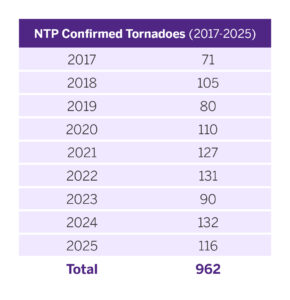
Among the year's key developments for NTP was the creation of innovative machine learning computer-vision tools designed to automatically identify tornado damage in forests and estimate tornado intensity.
"The ML-assisted year-end satellite imagery review turned up so many tornadoes and downbursts in Canada's northern forests that our seemingly quiet year became a moderately busy one," said David Sills, NTP director.
NTP engineers and meteorologists also developed a new method to estimate tornado strength using large debris - a technique that has already had international impact.
"Our research is helping improve how tornadoes are measured and understood," said Kopp. "One of our new tools was recently used by the U.S. National Weather Service to upgrade the rating of the Enderlin, North Dakota tornado to EF5, the first tornado to receive that rating in the United States since 2013."
The rise of generative artificial intelligence has also introduced new challenges for storm researchers. During the 2025 season, NTP received its first public report featuring an AI-generated image of a tornado.
"This is something we knew would eventually happen," said Sills. "Fortunately, our team was able to recognize the image as fake because we've collectively looked at thousands of real tornado photos over the years. But as generative AI tools get better and even start producing convincing videos verifying reports from the public will only become more challenging."
Researchers say careful verification of submitted photos and videos will become an increasingly important part of tornado investigation procedures.
"With any new technology there are both upsides and downsides," said Sills. "AI has enormous potential to help with research and analysis, but it also means we need to be more vigilant when evaluating reports to make sure the information we rely on is accurate."
Now in its seventh year of national operations, NTP conducted 548 investigations including 37 ground/remotely piloted aircraft systems (RPAS) or drone surveys. Researchers completed 450 satellite-based wind damage investigations and scanned satellite images of Canada's forested areas covering more than 3 million sq km with the help of a new, experimental AI-based tool. In total, NTP documented 352 events across Canada, including the aforementioned 116 tornadoes and an additional 103 downbursts.
Largest scientific database of hailstones in Canada
NHP also had a highly productive year in the field, significantly expanding Canada's understanding of hailstorms and their impacts.
During the 2025 storm season, NHP researchers completed 22 field missions, travelling more than 30,000 kilometres across hail-prone regions of the country. Over the course of those missions, the team sampled 26 hailstorms and collected roughly 2,500 hailstones, providing valuable data on storm structure, hail size and physical characteristics.
In addition to sampling hailstorms, the team conducted 12 forensic-level severe storm damage surveys, including detailed investigations following the July Calgary hailstorm and the August wind and hailstorm near Brooks, Alberta. These surveys help researchers better understand how hail and high winds interact with buildings, vehicles and infrastructure - information that can inform stronger building practices and improved resilience to severe weather.
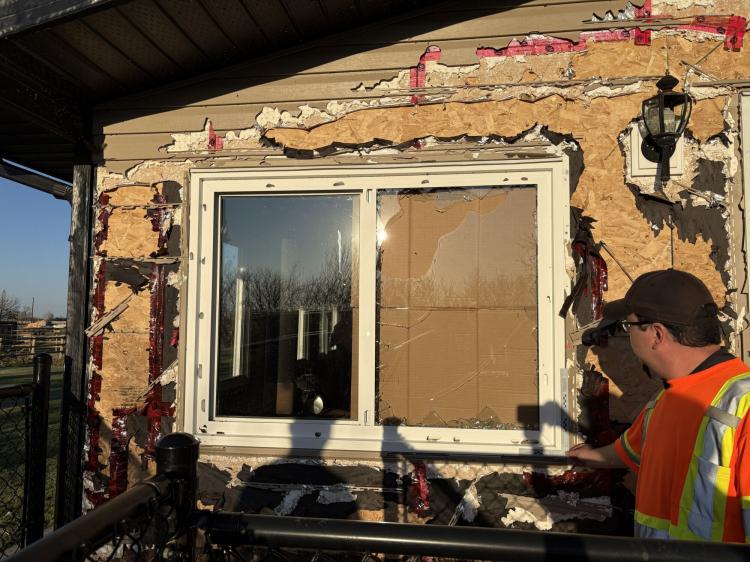
NHP investigators recording extreme wind-driven hail damage to a farmhouse NW of Brooks, Alberta, following a storm on August 20, 2025. (Simon Eng)
The NHP field program also included the design and deployment of four custom hail observation platforms developed for the ICECHIP' field campaign, the National Center for Atmospheric Research (NCAR)'s first in the United States dedicated to hail in more than 40 years. Built in partnership with Western University Machine Services, the platforms were used to capture detailed observations of hail as storms passed over monitoring sites. Four NHP students participated directly in field operations during the campaign, gaining hands-on experience in severe storm research while sharing their own experience from field operations in Canada with colleagues.
Additionally, NHP researchers processed approximately 3,400 hailstones in collaboration with the Permafrost ArChives Science Lab at the University of Alberta. The work is helping establish the largest scientific database of hailstones in Canada, allowing researchers to analyze hail size distributions, internal structures and other physical properties.
The team also completed 3D scans of more than 200 legacy hailpads (foam boards used to record hail impacts) in partnership with Rapid3D in Calgary. Alongside that work, researchers finalized new HailGen software that enables automated extraction of data from high-resolution hailpad scans, dramatically speeding up the analysis process.
According to NHP director Julian Brimelow, favourable weather conditions and an experienced field team helped make the season particularly productive.
"After two relatively quiet storm seasons in 2023 and 2024, 2025 brought a much more active summer for hailstorms," said Brimelow. "This was our fourth year in the field, and the combination of an experienced team, including several interns returning for another season, and continuous improvements to our field operations meant we were able to make the most of every mission and capture an exceptional dataset."
Most comprehensive observation network
NMP, launched in 2024, now integrates data from more than 3,000 weather stations across Canada, drawing from over 30 provincial and federal monitoring systems. The growing network is enabling researchers to better detect and analyze severe storms as they develop.
"The Northern Mesonet Project is becoming an increasingly important tool for understanding severe weather across Canada," said Connell Miller, NMP director. "There's tremendous interest in the data and the analytical tools we're developing and we expect the project to continue growing in the coming years."
By integrating new data sources, NMP has not only expanded surface weather station coverage across the country but has started building what will become Canada's most comprehensive severe weather observation network: the Canadian Mesonet Portal.
Already familiar to many Canadian forecasters and researchers, the portal is transforming how observation data are accessed and analyzed. Automated quality flags and new filtering tools now make it easier to identify reliable data, diagnose station issues and provide greater transparency for users.
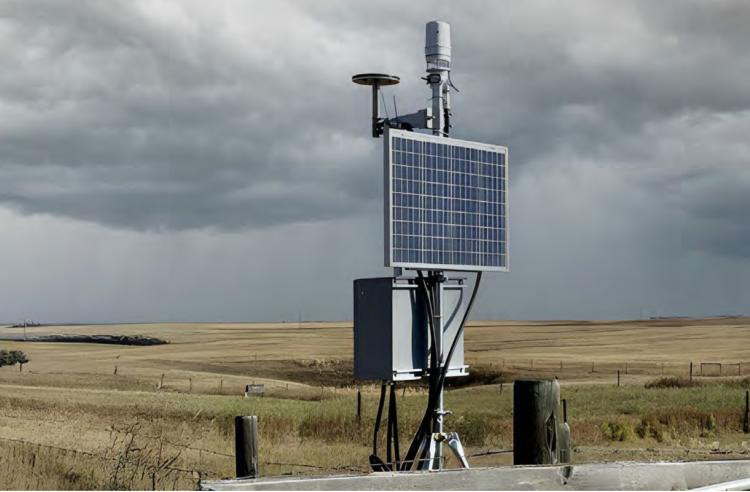
A severe weather monitoring station designed to capture detailed measurements of hail during storms. (Connell Miller)
Beyond storm detection, CSSL researchers are also working to improve how communities prepare for extreme weather. The team collaborates with the Institute for Catastrophic Loss Reduction and partners in the construction industry to develop stronger building practices designed to reduce damage from wind, hail and flooding.
Training the next generation of severe storms experts is another key focus. Over the past year, CSSL supported approximately 25 interns along with more than a dozen graduate students and post-doctoral fellows.
"The students and trainees working with us bring incredible energy and passion to this field," said Kopp. "Developing the next generation of meteorologists and engineers is one of the most important things we do."
As CSSL enters its second year, the team plans to expand its research capacity and continue strengthening partnerships that support severe storm research in Canada.
"We're grateful for the transformational support of our partners," said Kopp. "Their commitment allows us to expand the science, improve resilience and ultimately help protect Canadians from severe weather."