




A century-long commitment to protecting honey bees has reached an exciting milestone, as the Luckevich Pinchin Honey Bee Research Centre (HBRC) opens its doors to continue the University of Guelph's reputation as a leading centre for honey bee research and education.
The state-of-the-art facility features 15,000 square feet of education space, as well as new research labs, classrooms, workshops, bee breeding facilities, 300 managed hives and pollinator gardens.
"The Luckevich Pinchin Honey Bee Research Centre demonstrates U of G's leadership in advancing the future of agri-food," says Dr. John Cranfield, dean of the Ontario Agricultural College. "The centre has the capacity to expand its research impact, educate more students and beekeepers, and deepen its collaboration with industry partners."
The new facility will greatly increase the space available to the HBRC, which has been housed in a 60s-era bungalow for many years. The expanded centre offers greater opportunities to advance honey bee health and sustainable beekeeping through research, education, and industry collaboration, supporting resilient pollinator populations and the agri-food systems that depend on them.
The centre has been named for donor Lydia Luckevich and her late husband, Don Pinchin, founder of environmental consulting firm Pinchin Ltd. Luckevich is a long-time supporter of honey bee preservation efforts at U of G, leading efforts to build a new centre after attending one of the HBRC's weekend beekeeping courses.
"Honey bees are vital to global food systems and were essential to the Pinchin family's livelihood when they were apple farmers, so we as a family are very mindful of the importance of honey bee health," Luckevich says. "To feed today's world, pollinator research is absolutely essential and there is no better place to support this research than at the University of Guelph, which has been a leader in the field for over a century."
Bees facing greater threats
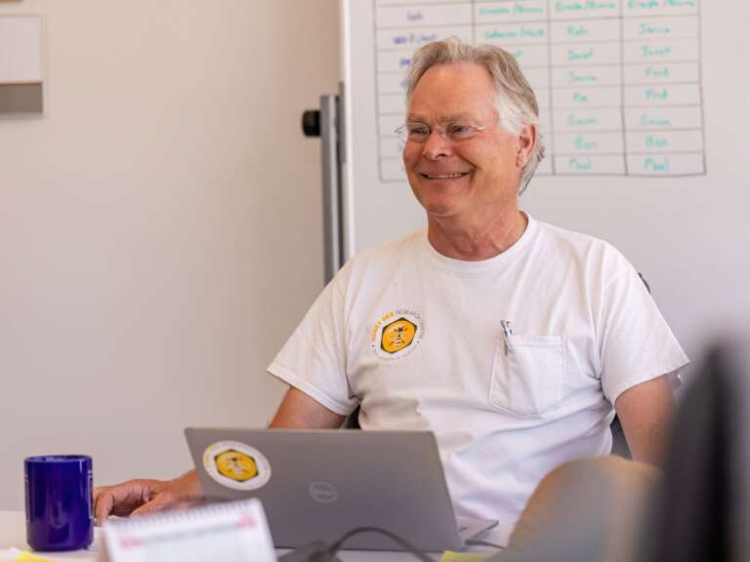
Paul Kelly is the research and apiary manager at the HBRC
The HBRC has a deep history at U of G, opening in 1894 as part of OAC. Beekeeping has changed a lot over the decades as producers deal with ever-growing challenges facing their hives.
"Beekeeping has gotten far more complex in recent years," says Paul Kelly, the HBRC's research and apiary manager. "People need to learn about the biology of the honey bees, but also the pests that affect them, climate change, nutrition and breeding."
While honey bee threats are growing, both amateur and professional beekeepers have also become more aware of the need to learn new methods of supporting bee health.
"Now there's much more interest in effective methods and that's really fuelled our growth," Kelly says.
Reducing death in honey bee colonies
The HBRC has a long tradition leading honey bee research, working to overcome threats and breeding bees more resilient to disease. The new space will allow them to further expand their work, adding rooms for bee incubation where researchers can conduct tests of bee behaviour and monitor bee and hive health. The new facilities also include a molecular biology laboratory focusing on honey bee genetics and diseases, 13 apiaries, an indoor colony overwintering room, and a large honey and hive product processing and bottling room.
"At a time when pollinator health is critical to the future of agriculture and food production, this investment strengthens the U of G's ability to deliver solutions with impact locally, nationally and around the world," says Cranfield.
The research team has spent decades working to understand mites and other pests wiping out honey bees. One of the most influential pieces of research is a 2007 study by Dr. Ernesto Guzman, which ranked threats to colonies. The Varroa mite, which kill bees by slowly feeding off them, was found to be the leading cause of honey bee death and the still-cited study has acted as a template for further research across the globe.
Educating the next generation of beekeepers
U of G students gain valuable hands-on experience at the HBRC through Apiculture and Honey Bee Biology, a course that welcomes between 800 and 1,000 students each year, including international students who take their learnings on honey bee health back home.
"That's more students taking an apiculture course than at any other institute in the world," Kelly says.
Education isn't just limited to university students. The HRBC team hosts weekend beekeeping courses, with plans to expand into more specific topics in the new centre. The team has also produced nearly 80 videos that are hosted on their YouTube channel. Those videos are freely available to beekeepers around the world, translated into 14 languages and have had more than 30 million views.
"When you do research, you reach a research community and it trickles down to some extent to the beekeeping community," he says. "But when you do education at an international level, it gets straight to the beekeeping community."
New centre to support future of HBRC
As the HBRC moves into the newly opened space, opportunities for future growth are endless.
"The expanded facility means we'll be able to manage a larger number of colonies," Kelly says. "This will give us greater opportunities for collaboration and doing research on a larger scale."
Visitors can learn more about the space and book a tour of the facility on the Luckevich Pinchin Honey Bee Research Centre's website.
Learn more about 100 years of honey bee research at the University of Guelph


