


A multi-year initiative is uniting artists, academics and audiences from across the globe to celebrate the diversity of contemporary circus.
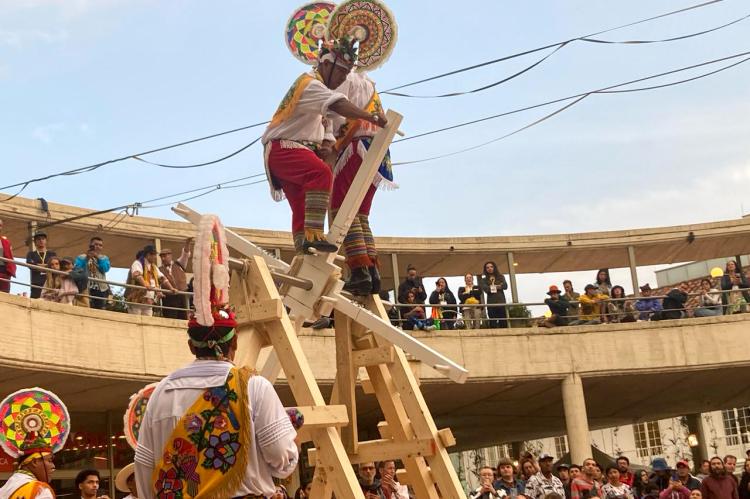
A Brock-supported initiative, Circus and its Others (CaiO), recently held a conference in Bogotá, Colombia. The conference featured a multimodal program of events that convened more than 70 scholars and showcased a circus festival featuring more than 100 artists. The Volodores de Papantla, pictured here, performed the Ceremonia ritual de los Guagas in the plaza of the Centro Cultural Gabriel García Márquez as part of the Achura Karpa festival programming. Photo credit: Nicolás Mahecha
Circus and its Others (CaiO), co-founded by Brock University Dramatic Arts Adjunct Professor Karen Fricker and Professor Charles Batson of Union College in New York, began in 2016 as a conference exploring representations of difference in circus.
Since its debut in Montreal, CaiO has gained momentum and a significant following of international circus artists and academics who are expanding the boundaries of circus studies.
"What started as a conversation between North America-based colleagues has blossomed into a truly global inquiry," said Fricker. "And the more we've broadened our perspectives to include traditions and cultures from the Global South, the richer the work has become."
Participants in the project come from a wide array of disciplinary backgrounds, including theatre and performance studies, anthropology, sociology, history, queer and gender studies, kinesiology, cultural studies. Their explorations of otherness and difference include studies of circus performances, labour and mobility practices, education and training, and colonial and post-colonial histories, among other topics.
"At its roots, CaiO has become a diverse global community made up of people coming together to share their identities, culture, art and scholarship with each other; the deep sense of shared purpose is profound," Fricker said.
The most recent CaiO conference was held in March 2024 in Bogotá, Colombia. A multimodal program of events convened more than 70 scholars and showcased a circus festival featuring more than 100 artists.
An editorial committee including Fricker, Batson and colleagues Julieta Infantino (Argentina), Marco Antonio Coelho Bortoleto (Brazil), Olga Lucía Sorzano (Colombia), and Aastha Gandhi (India) have since published the first of two special issues of the peer-reviewed journal Circus: Arts, Life and Sciences.
Focused on the theme "Transgressions and Challenges," the articles include an exploration of the work of female porters strong acrobats who lift, hold and support other acrobats in circus, an account of the Brazilian circus company A Penca, whose work engages with climate emergency and a critical look on the emphasis on aesthetic innovation in circus training.
The next CaiO conference is set for 2027 and will be held in Kerala, India. Based in Delhi, Aastha Gandhi is the co-organizer of the conference alongside Fricker and Batson.
Circus, Gandhi said, is deeply woven into her country's cultural tapestry.
"Hosting CaiO in Kerala is a momentous occasion. There is a rich and complex history of circus in India, impacted for decades by shifting sociopolitical landscapes. To have visitors come from many places to celebrate the art and complexity of circus today presents an exciting opportunity to share our perspectives with the world," Gandhi said.
Given the widespread interest in CaiO from circus artists and academics alike over the past decade, Fricker and Batson are turning their sights on continuing to build the project in a sustainable way, including archiving conference materials and performances and identifying new leadership models that reflect the inclusive values of the project.
"Experiencing the transformation of Circus and its Others into a robust, global inquiry is an immense privilege, and the work doesn't stop here. We want to continue to help make space for the many diverse and beautiful voices of contemporary circus for years to come," Batson said.
CaiO has been supported by the Department of Dramatic Arts, the Dean of Humanities Discretionary Fund, the Humanities Research Institute, Office of the Vice-President Research, Social Sciences and Humanities Research Council (SSHRC) of Canada, and the Canada Council for the Arts.